


Mistral Large 4 just arrived, and it is hard to miss.
The French AI company has unveiled a model with 1.05 trillion total parameters, 49 billion active parameters, multimodal capabilities and a very clear message for the rest of the industry: Europe is not ready to sit out the AI race.
And there is something almost absurd about the way Mistral has done it.
The model is internally nicknamed “Le Chonk.”
Yes, really.
But forget the funny name for a moment. Behind it is Mistral’s biggest AI system yet, trained on thousands of NVIDIA Blackwell GPUs in Europe and aimed at some of the most serious workloads in AI, from coding and cybersecurity to finance, engineering and visual understanding.
And if Mistral’s strategy works, this launch could make the AI race a lot more interesting.
Mistral Just Went Big
Mistral Large 4 is not simply another chatbot with a new name.
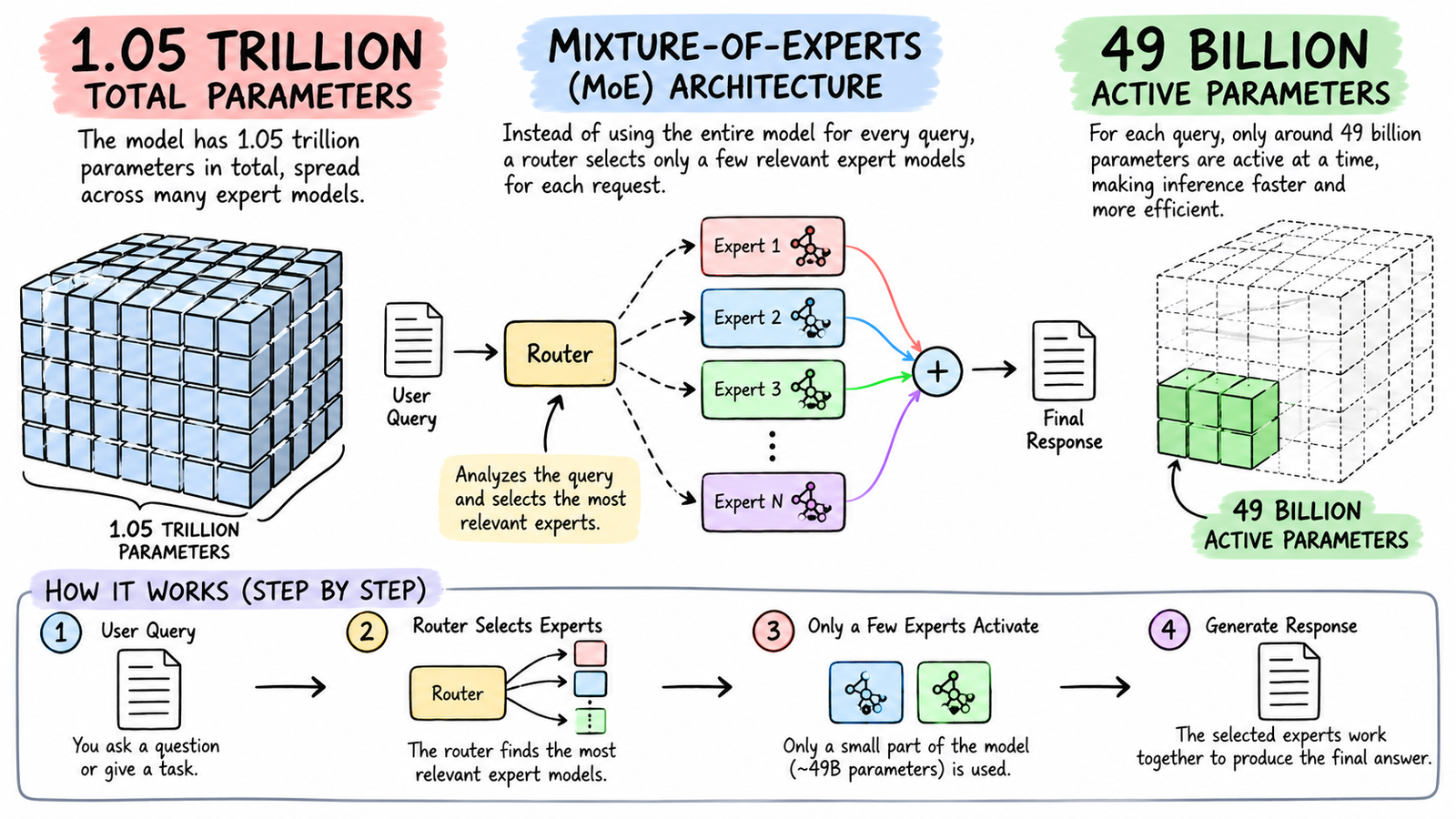
Mistral describes it as a new generation of open-weight, general-purpose multimodal AI built around a granular Mixture-of-Experts architecture. The headline number is enormous: 1.05 trillion parameters.
But there is an important detail hiding inside that number.
Only around 49 billion parameters are active during inference.
That means the entire trillion-parameter network is not being fired up for every single question. Instead, the model uses a sparse architecture that can route work through the parts of the system most relevant to the task.
It is a clever way of making a gigantic model more practical.
And the scale alone tells you something about where Mistral thinks the AI industry is heading.
Models are getting bigger. But they are also getting more specialized, more efficient and increasingly capable of doing actual work instead of simply generating answers.
You can see the technical details directly in Mistral’s official Large 4 documentation.
And Then There’s the Name
Somehow, Mistral managed to make a trillion-parameter AI model sound like a giant cat.
Le Chonk.
The nickname is a nod to the internet’s strange obsession with enormous fictional Mistral models, but this time the joke has landed remarkably close to reality.
There really is a massive new Mistral model.
And unlike the fictional versions that circulated online, this one is actually here.
That makes the nickname fun. The model itself is anything but.
A Trillion Parameters Is Only the Beginning
It would be easy to look at the 1 trillion parameter number and stop there.
But the more interesting question is what Mistral built all that capacity for.
Mistral Large 4 is designed to handle text and image inputs and is being positioned for workloads that go far beyond casual conversations.
Mistral is targeting software engineering, cybersecurity, financial analysis, manufacturing, satellite and aerial imagery, technical drawings and even chip design.
That changes the story.
This is not just a model that wants to answer your questions.
It wants to become part of the machinery that gets things done.
That shift is already happening across the industry. We saw another side of it in our coverage of AI agents starting to interact with the internet on their own. As models become more capable, the value is increasingly coming from what they can do with tools, information and real-world workflows.
And that multimodal part matters. Large 4 is not limited to reading text and predicting the next word. Mistral says the model can work with visual information as well, giving it a much broader range of potential applications.
For businesses, that could mean analyzing documents, technical diagrams, images and other information alongside ordinary text. For developers, it means the model can potentially become part of workflows where the input is not neatly organized into a simple text prompt.
Mistral Trained It on 4,000 Blackwell GPUs
This is where the launch gets even more serious.
Mistral says Large 4 was trained from scratch over roughly two months using 4,000 NVIDIA Grace Blackwell GPUs in its own European data centers.
That is a huge amount of computing power.
But Mistral is not just showing off the hardware. The company is making a much bigger point about where the model was built.
Europe.
For years, the AI conversation has been dominated by companies in the United States, while Chinese labs have increasingly pushed powerful open models into the market.
Mistral wants to establish a third serious position.
A European AI stack that can compete globally.
And that is becoming much more important than it might have looked a few years ago.
AI is no longer just a software product. Governments care about where sensitive AI workloads run. Companies care about data control. Security teams care about what a model can access and how it can be customized.
Mistral is trying to sit directly in the middle of that shift.
That is also why the hardware story matters. Building a frontier model requires an enormous amount of infrastructure, and Mistral is increasingly trying to own more of that infrastructure rather than relying entirely on someone else’s cloud.
Cybersecurity Is One of Mistral’s Biggest Bets
There is one area where Mistral is making an especially aggressive pitch: cybersecurity.
That might sound strange at first.
Why would an AI company want to put a huge model anywhere near cyber defense?
Because cybersecurity teams are already using AI to analyze code, investigate threats, understand vulnerabilities and automate parts of defensive work.
The problem is that security work can involve highly technical requests that sit uncomfortably close to the boundaries of what closed AI systems are willing to provide.
Mistral’s argument is that organizations need more control.
With an open-weight model, security teams can potentially deploy and customize the system themselves instead of depending entirely on the rules of a remote AI provider.
That does not magically make AI safe.
It does, however, change who gets to decide how the system is used.
And that distinction could become extremely important as AI agents become more powerful.
We recently looked at the other side of that problem in our story about NVIDIA’s push to build stronger safety boundaries around AI agents. Mistral is approaching the broader AI security question from a different direction: give organizations more control over the model itself.
Reuters also reported that Mistral is positioning Large 4 as a model that can compete with some Chinese open-weight systems, including in cybersecurity. The company has given cybersecurity experts and government authorities early access during the preview period.
That is a revealing choice. Mistral is not treating cybersecurity as some side feature buried in the product page. It is using the category as part of the argument for why open-weight AI can matter strategically.
Mistral Is Also Taking Aim at China’s Open-Model Lead
There is another reason this launch matters.
China has been moving fast.
Companies such as DeepSeek, Alibaba and other Chinese AI labs have helped make open-weight models a much more serious threat to the dominance of closed Western systems.
Mistral now wants to push back.
The company says Large 4 is among the strongest open-weight models globally and claims it is the strongest open-weight model developed outside China.
That is a big claim.
And it is worth treating it as a claim for now, rather than a final verdict.
The model is only entering public preview. Independent researchers and developers still need time to test it under comparable conditions across coding, reasoning, visual tasks and real-world workflows.
That is why the next few weeks may matter more than today’s launch announcement.
Early benchmark numbers can look impressive, but benchmarks are not the same thing as real-world dominance. Different models can use different tools, prompts, agent setups and evaluation methods. A model that wins one test can still lose badly on another.
So the real test for Large 4 will come when developers can use it outside Mistral’s own evaluation environment.
The Real Plot Twist Is What Happens on October 27
Right now, Large 4 is entering a public preview period.
But Mistral has already put a date on the calendar that developers will be watching closely.
October 27.
That is when Mistral plans to release the model weights publicly.
And that is when the conversation changes.
Until then, people are mostly looking at Mistral’s announcement, early access and preliminary performance claims.
Once the weights are available, developers can start testing the model in their own environments, researchers can investigate it more deeply and businesses can figure out whether it actually fits their workloads.
That is the difference between an impressive launch and a model that actually changes the market.
It also gives Mistral a short window to keep improving the model before that wider release. The company says training and reinforcement learning work will continue during the preview period.
And This Is Where Open Weight Gets Interesting
The biggest advantage Mistral is selling is not simply raw intelligence.
It is control.
Closed AI systems can be incredibly powerful, but users are ultimately dependent on the company operating the model.
With open weights, organizations can get much deeper control over deployment, customization and infrastructure.
For a developer, that can mean experimenting with the model directly.
For a company, it could mean deploying AI closer to sensitive data.
For a government, it could mean building AI infrastructure under its own control instead of depending completely on a foreign provider.
Those advantages come with tradeoffs, of course. Open weights do not automatically guarantee security, reliability or responsible use.
But the strategic appeal is obvious.
You get more control over what happens after the model leaves the lab.
That matters even more when the model is intended for sensitive areas such as cybersecurity, finance and government workloads.
Mistral Is Not Trying to Win With Size Alone
It would be easy to turn this into another “bigger model wins” story.
That would miss the point.
Mistral Large 4 having a trillion parameters does not automatically make the AI model smarter than everything else. Architecture matters. Training matters. Data matters. Inference efficiency matters. And real-world performance can look very different from a benchmark chart.
Mistral itself still has work to do. The company says the model will continue improving as reinforcement learning progresses and more compute becomes available.
So this is not the final version of the story.
It is the opening move.
That is actually what makes the launch interesting. Mistral does not need Large 4 to instantly destroy every competing model. It needs to make developers curious enough to try it, enterprises confident enough to evaluate it and governments interested enough to consider it as an alternative.
Europe Just Made the AI Race a Little More Complicated
There is a bigger geopolitical story hiding underneath the technical details.
The AI industry increasingly looks like a three-way fight.
American companies are pushing some of the world’s most capable closed models. Chinese companies are producing increasingly competitive open-weight systems. And now European companies are trying to make sure they are not forced to choose between the two.
Mistral is probably Europe’s clearest symbol of that effort.
The company recently raised €3 billion in funding and is expanding its computing infrastructure across Europe. Large 4 is the next big demonstration of what that investment is supposed to produce.
A European model that can compete globally.
Not just in a research paper.
In actual businesses.
That ambition is a big reason this launch matters beyond the model itself. If Mistral can turn its technology into a serious enterprise platform, Europe gets more than another AI chatbot. It gets a company capable of building part of the infrastructure underneath the AI economy.
But Can It Actually Beat the Giants?
This is the question everyone is going to ask.
And right now, the honest answer is we do not know yet.
Mistral’s early results look competitive, particularly among open-weight models. But independent testing is still catching up, and benchmark results can change significantly depending on the evaluation setup.
So this is not the moment to declare Mistral the new king of AI.
That would make for a great headline.
It would also be premature.
The more interesting question is whether Mistral can make Large 4 useful enough, efficient enough and controllable enough that companies actually choose it over closed alternatives.
That battle will be decided in the real world.
And there is another reason not to rush to a verdict. Large 4 is entering the public while the entire AI market is moving extremely quickly. New models, agent systems and specialized AI products are appearing constantly. Being impressive today is not enough. Mistral has to keep improving while making the model practical for developers and businesses.
The AI Race Is Changing Shape
Something important is happening underneath all these model launches.
The AI industry is slowly moving away from a simple question:
“Which chatbot gives the best answer?”
The new question is much bigger:
“Which AI can actually become part of the way we work?”
That means coding. Research. Finance. Cybersecurity. Engineering. Documents. Images. Software tools. Agents.
And eventually, computers that can act on our behalf.
We saw how serious that shift is becoming in our recent story on Apple changing how macOS handles powerful permissions for AI agents. The technology is getting more capable, but the bigger question is how much control users and organizations should retain as that capability grows.
We also looked at a very different side of the same transformation in our coverage of Tavus and its AI video Turing test. That story showed how convincing AI can become when it interacts with people in real time. Large 4 points toward the other side of that evolution: AI that does not just interact with you, but starts doing serious work for you.

So, Is Mistral Large 4 Actually a Big Deal?
It could be.
Not because one trillion parameters automatically makes a model unbeatable.
Not because Mistral has suddenly defeated OpenAI, Anthropic or China’s best AI labs.
And definitely not because Europe has suddenly won the AI race.
None of that has been proven.
The interesting part is what Mistral is attempting.
A European AI company has built a 1.05 trillion-parameter multimodal model, trained it on thousands of Blackwell GPUs, aimed it at serious enterprise workloads and chosen to make its weights available rather than keeping the entire system locked behind a traditional closed API.
That is a serious bet.
And if the model performs as well in the wild as Mistral hopes, the open-model race could suddenly become much harder to predict.
The Bottom Line
Mistral Large 4 is huge, ambitious and, thanks to its unofficial nickname, slightly ridiculous.
But underneath the “Le Chonk” joke is a very serious strategy.
Mistral wants to prove that a European company can build a frontier-level AI model, compete in the open-weight market and give businesses and governments more control over how powerful AI gets deployed.
The model is only at the beginning of its public life.
Developers still need to test it. Researchers still need to challenge it. Businesses still need to decide whether it is actually useful.
And then there is October 27.
That is when the planned public release of the model weights could turn today’s launch from an impressive announcement into something much bigger.
Because the next phase of the AI race may not be about who has the biggest model sitting inside a data center.
It may be about who can put that intelligence into the hands of everyone else.
And Mistral just made its move.
Now the interesting part begins.