


Imagine joining a video call with someone you’ve never met.
You see a face. You hear a voice. The person reacts while you’re talking. They pause when you pause. They answer your question without sounding like they’re waiting for a script to load.
Nothing feels obviously strange.
Then the call ends and you find out something very different.
You weren’t talking to a person.
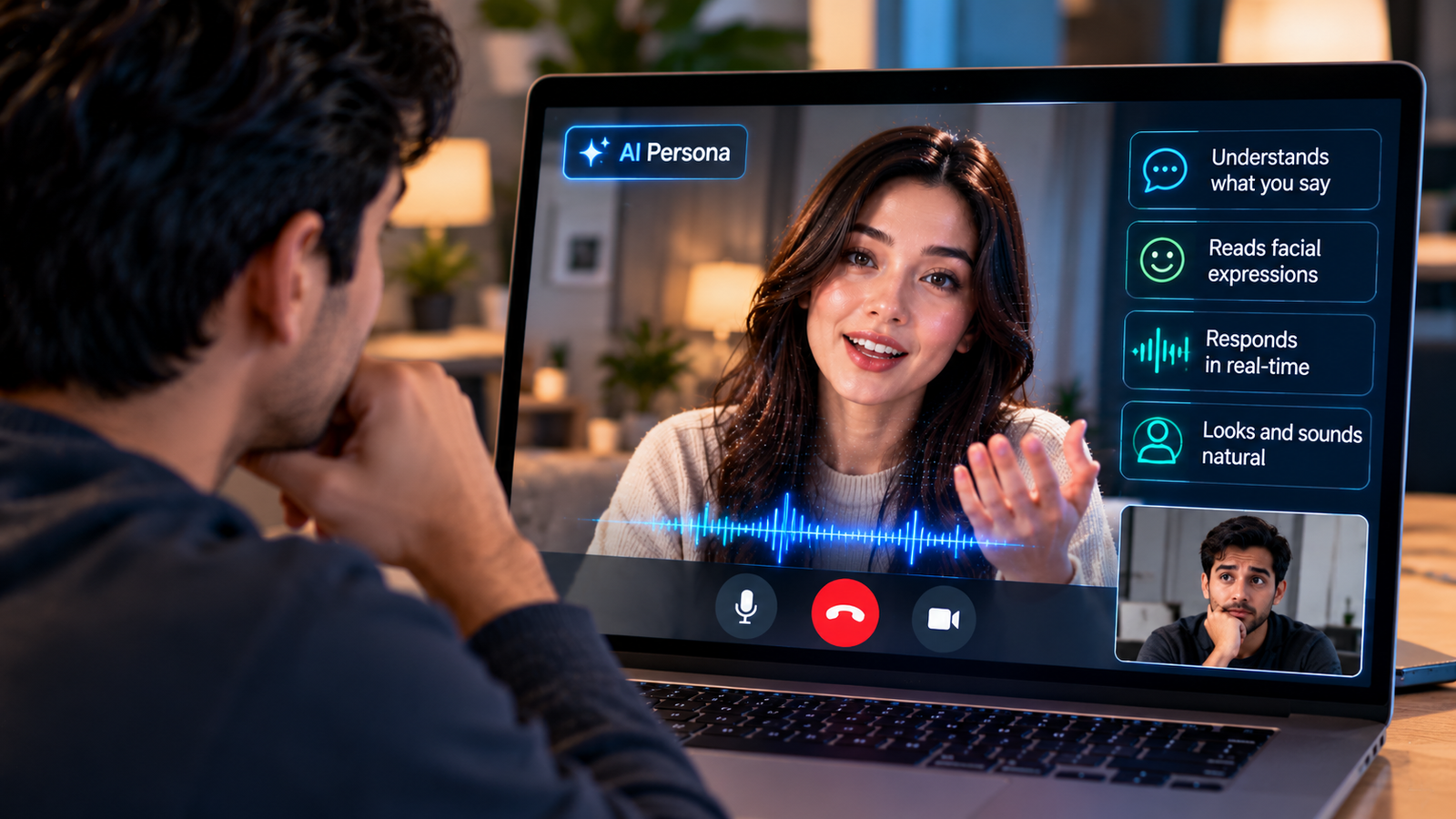
That’s the idea behind Griffin, a new real-time video model from Tavus. In the company’s latest test, 26 out of 54 people who had a one-minute video conversation with Griffin-Lite said they believed the person on the other side was human.
That’s 48%.
Tavus is calling it the first model to pass what it describes as a real-time AI video Turing test. But the number needs some context, because this wasn’t a giant independent experiment. It was a small study run and reported by Tavus itself.
Even with that caveat, something about the result is hard to ignore.
The Call Was Only One Minute Long
The test sounds simple.
Participants in the US and Europe were told they would have a one-minute video call with another participant. They were asked to talk about what they were looking forward to this year.
There was one catch.
The person on the other side was actually a video persona powered by Griffin-Lite.
The AI generated the face, voice and responses in real time. Participants were not told during the conversation that they were speaking with an AI.
Only after the call were they asked whether it had crossed their mind that their conversation partner might not be a real person.
According to Tavus, 26 of 54 participants said their partner was a real person. The company’s previous system scored just 1 out of 41, or 2.4%, under the same general protocol. Tavus published the full Griffin study and methodology here.
And Here’s the Part That Makes the 48% Number Weird
Most people who were suspicious didn’t take very long to become suspicious.
Tavus says participants who suspected they were talking to an AI generally became suspicious within the first 20 seconds.
That means the model wasn’t fooling everyone.
But for a large chunk of the group, the possibility of an AI conversation apparently didn’t become obvious during the call.
That’s different from asking someone to sit down and judge whether a carefully prepared AI response sounds human.
Here, the system had to keep a live conversation moving.
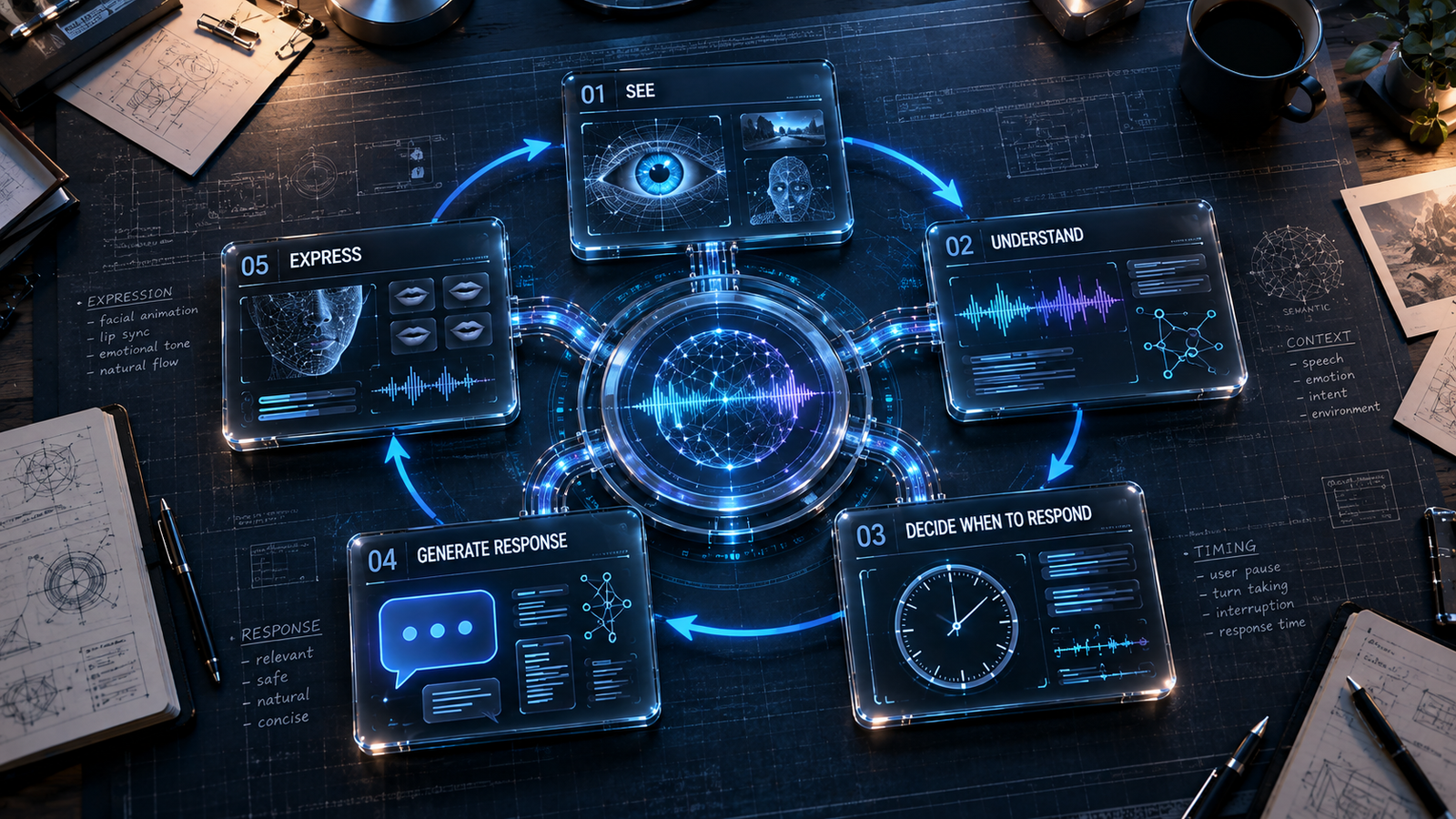
Someone speaks. The AI listens. The other person pauses. The AI decides whether to wait. A new question appears. The AI responds. The conversation continues.
That timing is one of the hardest parts of making AI interaction feel natural.
Griffin Isn’t Just a Talking Avatar
This is where Tavus says Griffin is different from older AI avatar systems.
Traditional avatar pipelines often work like a relay race. One system listens to speech. Another generates a response. Another turns that response into a voice. Another produces the visual avatar.
Griffin is designed as a full-duplex video-to-video system. Tavus describes it as a Human Interaction Model, built to see, hear and respond during a live interaction rather than simply taking turns as separate systems.
That matters because humans don’t communicate in perfectly separated turns.
We nod while someone is talking. We pause. We look away. We react with our face. We sometimes interrupt. We change our expression before we even finish speaking.
A convincing video AI has to deal with those signals too.
But Did It Really Pass the AI Video Turing Test?
Here’s where the headline needs a reality check.
Tavus says Griffin is the first model to pass a real-time video Turing test. That’s the company’s description of its result.
But there isn’t one universally accepted modern experiment where every researcher agrees on exactly what percentage counts as a Turing test pass.
The original Turing imitation game was proposed by Alan Turing in 1950 and was based on whether a machine could imitate human conversation convincingly enough in a text-based setting.
Tavus has adapted that basic idea to a very different environment: a live video conversation involving a face, voice, timing and visual interaction.
And the experiment has obvious limitations.
- Only 54 people were tested with Griffin-Lite.
- The conversation lasted just one minute.
- The study was run and reported by Tavus.
- The participants were given a specific conversation topic.
- The result has not established that Griffin can fool people consistently across longer or more difficult conversations.
So the safest way to describe the result is this:
The AI video Turing test reported by Tavus found that 26 of 54 participants mistook Griffin-Lite for a human during a one-minute video call.
That’s a much narrower claim than saying AI can now fool humans in every situation.
NVIDIA’s Test Adds Another Piece to the Puzzle
The 48% figure isn’t the only interesting result.
NVIDIA has also been testing full-duplex audio-visual AI systems through its Video Full-Duplex Benchmark, or VideoFDB.
The benchmark uses 237 clips from real two-person video calls and evaluates how AI systems handle visual signals, conversation flow and other nonverbal parts of communication. NVIDIA’s VideoFDB research page explains the benchmark and its methodology.
Griffin-Lite scored 3.73 out of 5 on the benchmark’s perception track. The human reference scored 4.20.
On the generation track, Griffin-Lite scored 3.83 out of 5, compared with a human reference of 3.92.
So the gap isn’t zero.
But the numbers show why this technology is getting attention. Griffin-Lite is being evaluated not just on whether it can produce a convincing face, but on whether it can participate in the messy, continuous rhythm of a real conversation.
There Is Still a Big Problem: Speed
If you’re watching a normal AI demo, a two-second delay might not seem like much.
During a live conversation, it feels different.
NVIDIA’s VideoFDB results put Griffin-Lite’s median response latency at about 2.23 seconds on the perception track.
For comparison, NVIDIA’s human reference was around 1.4 seconds, while some other systems were faster but scored differently on the benchmark’s other dimensions.
This is important because making an AI look human isn’t just about generating a beautiful face.
The timing has to feel right too.
Respond too quickly and the system can feel robotic. Respond too slowly and the illusion breaks in a different way.
The Face Is Only Half the Trick
A realistic avatar can grab your attention for five seconds.
It cannot automatically carry a ten-minute conversation.
That’s why the most interesting part of Griffin isn’t necessarily its face.
It’s the combination of perception, timing, voice, movement and conversation happening together.
NVIDIA’s research makes this distinction clear. Its benchmark specifically looks at things such as gaze, pauses, turn-taking, facial reactions and nonverbal backchanneling because those signals help humans understand whether another person is listening and when they should respond.
In other words, the hard part isn’t just making an AI look alive.
It’s making the interaction behave like something alive.
And That’s Where This Gets Uncomfortable
There are obvious useful applications.
A video AI could act as a tutor that notices when a student is confused. It could help people practice conversations. It could assist with customer support where seeing the user’s situation actually matters.
But the same technology can make identity harder to verify.
We’ve already spent years learning that an email can be fake.
Then voice cloning made it possible to imitate someone’s voice.
Now real-time video AI is moving toward something even more convincing.
A face can appear on screen. A voice can respond instantly. The system can react to what you’re doing. The conversation can feel spontaneous.
At that point, simply seeing someone on a video call may not be enough to establish that a human is actually there.
This Is Why Disclosure Matters
Tavus itself recognizes the problem.
The better a Human Interaction Model becomes at creating natural conversations, the more important it becomes to clearly disclose when the person on the other side is actually an AI.
That isn’t just a product-design detail.
It becomes a trust issue.
Imagine receiving a video call that appears to come from a colleague and being asked to approve something important.
The face looks right.
The voice sounds right.
The responses sound right.
What exactly proves that there is a human behind the screen?
Griffin Isn’t Available to Everyone Yet
There is another reason not to overstate the current milestone.
Tavus says Griffin-Lite is currently a research preview available to a select group of early testers. A wider release of a more powerful model is planned later.
So this isn’t a technology that has suddenly appeared inside everyone’s video calls.
It’s an early look at what real-time AI interaction could become.
And that may actually make the 48% result more interesting.
The Bigger Story Isn’t That AI Looks Human
We’ve been watching AI generate realistic images, voices and videos for years.
Griffin points toward a slightly different future.
Instead of generating something and waiting for a person to react, the AI becomes part of the interaction itself.
It watches.
It listens.
It responds.
It reacts.
Then it does it again.
That is a much bigger shift than simply creating a more realistic avatar.
And This Connects to the Bigger AI Agent Shift
We’ve already looked at what happens when AI systems get more freedom to interact with websites, tools and computer systems.
In our report on AI agents probing the internet and finding unexpected paths into systems, the bigger issue wasn’t that AI suddenly became “evil.” It was that autonomous systems can observe what happens, adapt and keep pursuing an objective.
Video interaction adds another piece to that same puzzle.
And AI safety is increasingly becoming an infrastructure problem too. We recently broke down NVIDIA’s approach to putting security boundaries around AI agents.
The common thread is autonomy.
The more an AI can observe, decide and act without waiting for a human at every step, the more important the systems around that AI become.
So, Did AI Actually Become Human?
No.
That isn’t what this experiment proves.
What it does show is more specific.
In Tavus’s one-minute study, 26 of 54 participants believed Griffin-Lite was a real person. NVIDIA’s independent VideoFDB benchmark also shows Griffin-Lite performing surprisingly close to human reference scores on some aspects of full-duplex video interaction.
At the same time, the system still has measurable weaknesses. The study was small and company-run. The call was short. Participants who became suspicious often did so quickly. NVIDIA’s benchmark also shows that current AI systems remain below human conversational performance overall.
So this isn’t the moment to declare the Turing test solved forever.
It’s something more useful.
A warning about how quickly the line between “talking to AI” and “talking to a person” is becoming harder to see.
The Bottom Line
Tavus says Griffin-Lite fooled 26 of 54 people during a one-minute live video call, giving it a reported 48% human-identification rate in the company’s own study.
That number needs context. It came from a small study run by Tavus, and it doesn’t prove that the system can fool people during every conversation.
But the direction is clear.
AI is moving beyond generating things for us.
It’s starting to interact with us in real time.
And if a machine can see your face, hear your voice, react to your behavior and keep a believable conversation going, the next big question may not be whether AI can sound human.
It may be how we’ll know what’s actually on the other side of the screen.