
Imagine discovering that a website you use every day has a security flaw. Your passwords, personal information, or financial details could be at risk, and the people running the website might not even know the problem exists.
Now imagine an AI system that can examine the software, spot a weakness, test whether it can actually be exploited, and help write a fix. That is the kind of work Google says its newest AI model can handle.
Meet Gemini 4 Carbon, Google’s latest frontier AI model, announced on October 28, 2026. It is designed for demanding coding tasks and cybersecurity work, and the company is making some impressive claims about what it can do.
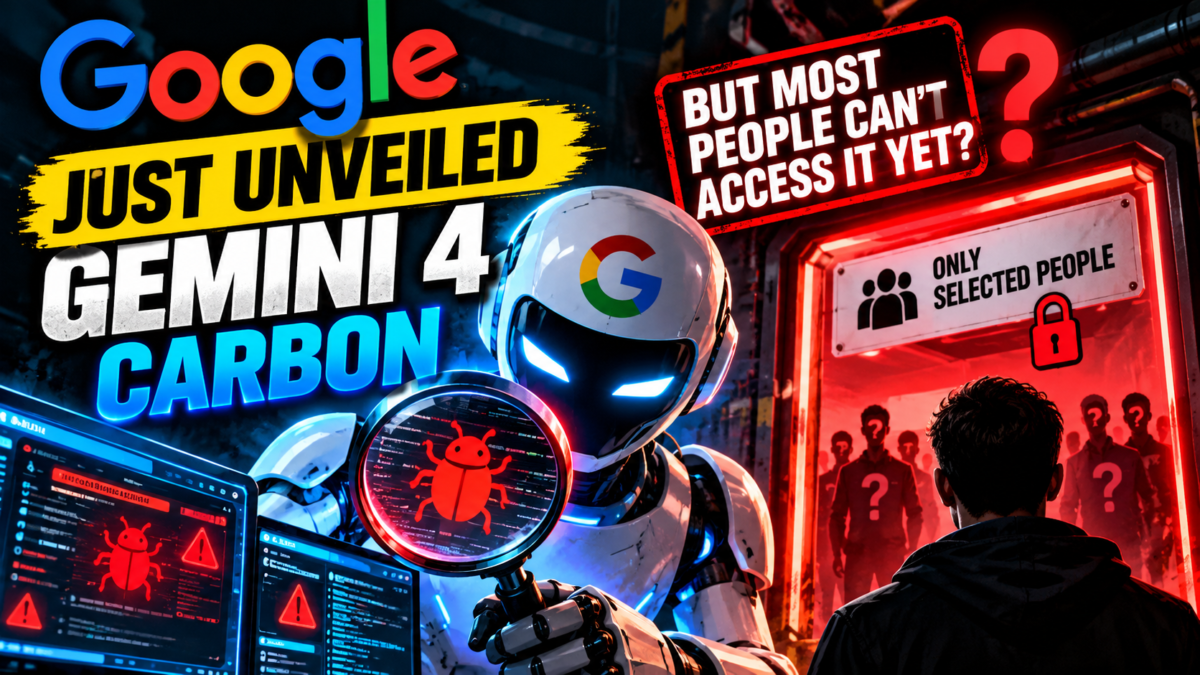
But here is the twist. You cannot simply open a chatbot and start experimenting with it. Google is initially giving access to selected cybersecurity defenders while it continues testing the model’s safeguards.
Why release a powerful AI model and then keep access limited? And what exactly can it do that makes this launch worth watching? The details are more interesting than another announcement about a chatbot getting smarter.
This AI Is Not Just Writing Code. It Is Trying to Find What Is Broken.
Think about the last time an app crashed, a website showed a weird error, or a software update broke something that worked perfectly yesterday. Finding the cause can take hours, sometimes much longer. A developer may need to read thousands of lines of code before spotting the tiny mistake causing the problem.
Cybersecurity makes that job even tougher. Some weaknesses are buried deep inside software and only become obvious when several parts of a system interact. Finding the flaw is one challenge. Working out whether someone could exploit it is another. Fixing it without breaking something else is a third.
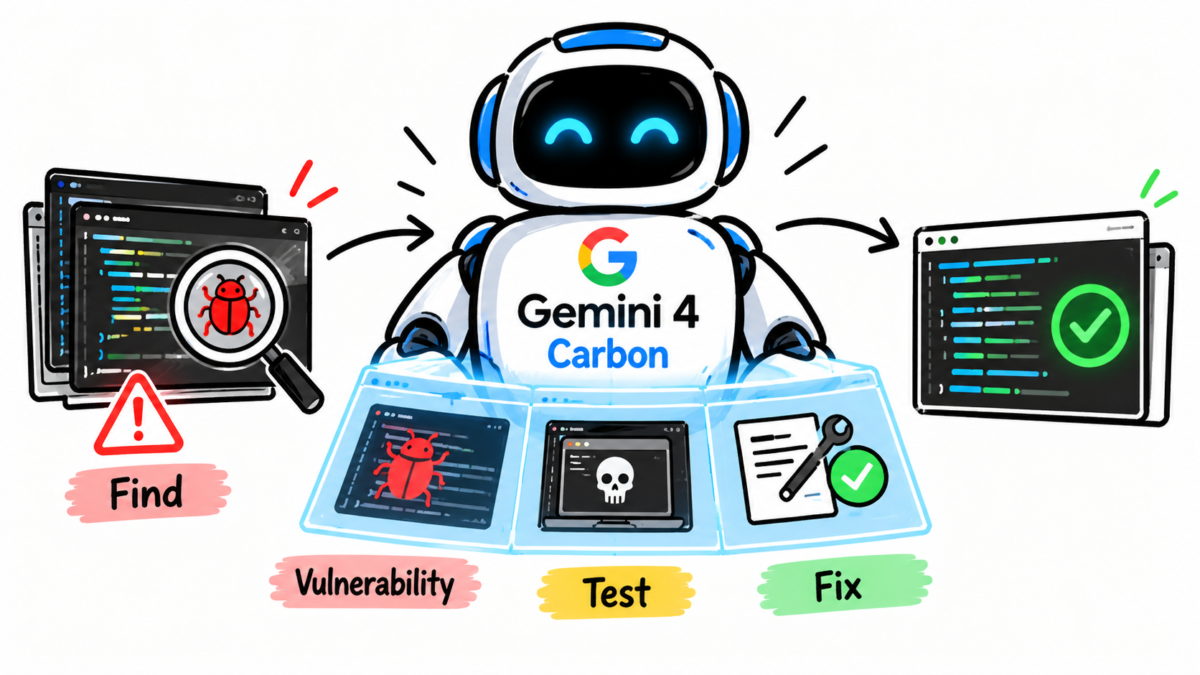
Google says Gemini 4 Carbon is built to work through these kinds of complicated, multi-step problems. It can investigate code, explore possible explanations, test approaches, and help generate patches instead of stopping at a quick suggestion.
The model builds on Gemini 4 Argon, which Google introduced roughly two weeks earlier. According to Google’s official announcement, Carbon is designed for more demanding engineering tasks that may require sustained work over a long period.
That is a pretty big shift in what people expect from AI. Instead of asking a model to write a small piece of code and checking the result yourself, developers are moving towards systems that can help investigate an entire problem from beginning to end.
Of course, helping with a repair is not the same as guaranteeing a perfect fix. The code still needs to be tested, and security teams need to verify the results. But if the model can genuinely reduce the time spent finding difficult bugs, that could be useful for the people responsible for keeping software safe.
The Numbers Behind Gemini 4 Carbon Are Turning Heads
Google did not just say that Carbon is good at cybersecurity and leave it there. The company published results across three benchmarks that look at different stages of the job, from finding a software weakness to checking whether it can be exploited and trying to fix it.
Here is what Google reported in its launch announcement:
- 88.2% on SEC-bench Pro: A benchmark focused on finding vulnerabilities in real-world software.
- 54.8% on ExploitGym: A benchmark that evaluates whether a model can validate vulnerabilities by demonstrating exploitability in controlled tests.
- 71.0% on CWE-bench: A benchmark focused on repairing software weaknesses.
Put those numbers together and you get a more useful picture of what Google is aiming for. Finding a suspicious line of code is one thing. Establishing that the problem matters and preparing a working repair is a much more demanding task.
Google also says Carbon generated secure code at more than twice the success rate of Gemini 4 Argon on its internal benchmarks. Its Chrome team reported that Carbon performed more than ten times better than a rival frontier model in its evaluation of high-quality patch generation.
Those are impressive claims, but there is an important detail that should not get lost in the excitement. These results come from specific evaluations reported by Google. They do not mean Carbon will discover every vulnerability or produce a perfect repair every time.
Independent evaluations and real-world use will help show how well the results translate outside those tests. SecurityWeek’s coverage of the launch provides additional context on the reported cybersecurity results.
Still, the direction is clear. Google wants AI to do more than suggest what a developer should try next. It wants the model to help investigate the problem, check the evidence, and work towards a solution.
So Why Can’t Everyone Use It Yet?
This is where the announcement gets interesting. With many AI launches, the big question is how quickly everyone can try the new model. With Gemini 4 Carbon, the first question is who gets access at all.
Google is initially making Carbon available to a subset of cybersecurity defenders. It plans to expand access gradually to additional trusted partners through its Fairwind Program, while continuing to gather feedback and improve safeguards.
The reason is easier to understand when you look at both sides of cybersecurity.
Suppose a company discovers that its payment system has a vulnerability. A security team could use a capable AI model to investigate the weakness, understand the potential impact, and prepare a patch before someone else takes advantage of it.
Now consider the other side. A person with bad intentions could try to use similar capabilities to investigate software they have no permission to access. A tool that helps defenders identify weaknesses can also create risks if its capabilities are misused.
The tricky part is that the underlying technical ability can be useful in both situations. The difference comes down to who is using it, what they are allowed to do, and how the system is controlled.
That is why Google is taking a gradual approach instead of immediately opening Carbon to every user. The company says it is continuing to test safeguards before making the model available more broadly through its products.
To be clear, Google has not said that Carbon will always remain restricted. It plans to expand availability to developers, businesses, and consumers, but it has not provided a specific public-release date.
So if you were hoping to try it today, there is no confirmed date to put on your calendar. For now, the rollout is focused on selected defenders and trusted partners.
The Same AI Could Become a Security Team’s Best Friend or a Serious Headache
Imagine a security team responsible for an app used by millions of people. It has new updates to review, old code to maintain, and possible vulnerabilities to investigate. There is never a shortage of work, and every hour spent chasing a false alarm is an hour not spent on another problem.
A capable AI assistant could help the team inspect code faster, investigate suspicious behaviour, and prepare fixes for developers to review. In the best case, the team spends less time on repetitive investigation and more time addressing the problems that actually matter.
But there is a catch. AI can misunderstand code, miss important context, or suggest a patch that looks correct but fails when tested. A security team still needs to validate what the model finds, restrict its permissions, and check its actions.
This issue becomes even more important when AI systems can use tools and carry out actions without waiting for a person after every step. Our coverage of NVIDIA’s approach to AI agent safety explores why setting boundaries around autonomous systems matters as their capabilities grow.
We have also looked at 90 AI agents investigating a material that had been known for 27 years. That story focused on scientific discovery, but it reflects the same broader shift towards AI systems that can work through complicated tasks rather than simply answer one question.
With cybersecurity, the stakes can be higher because the system may be examining weaknesses that affect real software and real users. Strong performance matters, but control and verification matter just as much.
Carbon’s success will therefore depend on more than how well it performs on a benchmark. Security teams will need to see whether it helps them find meaningful issues, whether its patches hold up, and whether it can be used safely within their existing workflows.
How Much Will Gemini 4 Carbon Cost?
Google announced introductory API pricing of $2 per million input tokens and $10 per million output tokens. Cached input tokens receive a 95% discount compared with the standard input price during the introductory period.
After the introductory period, Google says the prices will increase to $4 per million input tokens and $20 per million output tokens. These are usage-based API prices, so the actual bill depends on how much the model processes and generates.
For example, a short coding request and a long task that involves inspecting a large codebase, testing several approaches, and preparing a detailed patch can consume very different amounts of tokens.
That also means the lowest price per request does not necessarily make a model the best value. A business would need to consider how reliably the model completes the work, how much time it saves, and how much human review is still required.
Google’s pricing makes the model’s intended developer and business use clearer, but paying for access is not the only consideration right now. Carbon is still in its limited rollout, so the advertised price does not mean everyone can start using it immediately.
For more on the announcement and pricing, Reuters’ report on Gemini 4 Carbon also covers Google’s move into more advanced coding and cybersecurity systems.
What This Means for the AI Race
AI competition is no longer just about which chatbot gives the cleverest answer. Companies are trying to build systems that can work through complex tasks, use tools, and produce results that are useful beyond a conversation window.
That is one reason new model launches are increasingly focused on coding, research, and agent-based work. Our earlier coverage of Mistral Large 4 and its huge AI architecture looked at another part of this competition: the models and technical approaches that companies believe can push the technology forward.
Carbon takes a particularly sensitive route into this race. If its reported results translate into practical benefits, it could help security teams investigate flaws more quickly and prepare fixes with less manual effort. That would be useful for companies that maintain large amounts of software.
But the industry’s next challenge is proving that such systems can perform reliably outside carefully chosen tests. Companies will need evidence that their models work under real conditions, that their costs make sense, and that their safeguards can handle misuse attempts.
That is what makes the limited rollout worth watching. The next major development will not just be another benchmark announcement. It will be seeing how Carbon performs as more approved defenders get the opportunity to use it.
The Bottom Line
Gemini 4 Carbon is Google’s latest attempt to make AI useful for serious engineering and cybersecurity work. The company says it can help find software vulnerabilities, validate risks, and generate patches, with strong reported results across several benchmarks.
But the rollout tells an equally important story. Google is giving selected cybersecurity defenders access first while it continues refining the safeguards around the model. Broader availability is planned, although a public-release date has not been announced.
There is genuine potential here. If the model proves useful in real deployments, it could help teams identify and repair software weaknesses more efficiently. At the same time, its capabilities make responsible access and human verification essential.
For everyday users, the immediate takeaway is simple: Google’s new model is not yet a tool everyone can try. For developers and security professionals, the more interesting question is what happens when AI can do more of the difficult work involved in keeping software secure.
The next big AI breakthrough might not be the chatbot that talks best. It might be the one that finds the problem everyone else missed.