


Every time you ask an AI chatbot a question, the answer appears almost instantly. You type a prompt, watch a few words appear on your screen, and get a result that can feel almost magical.
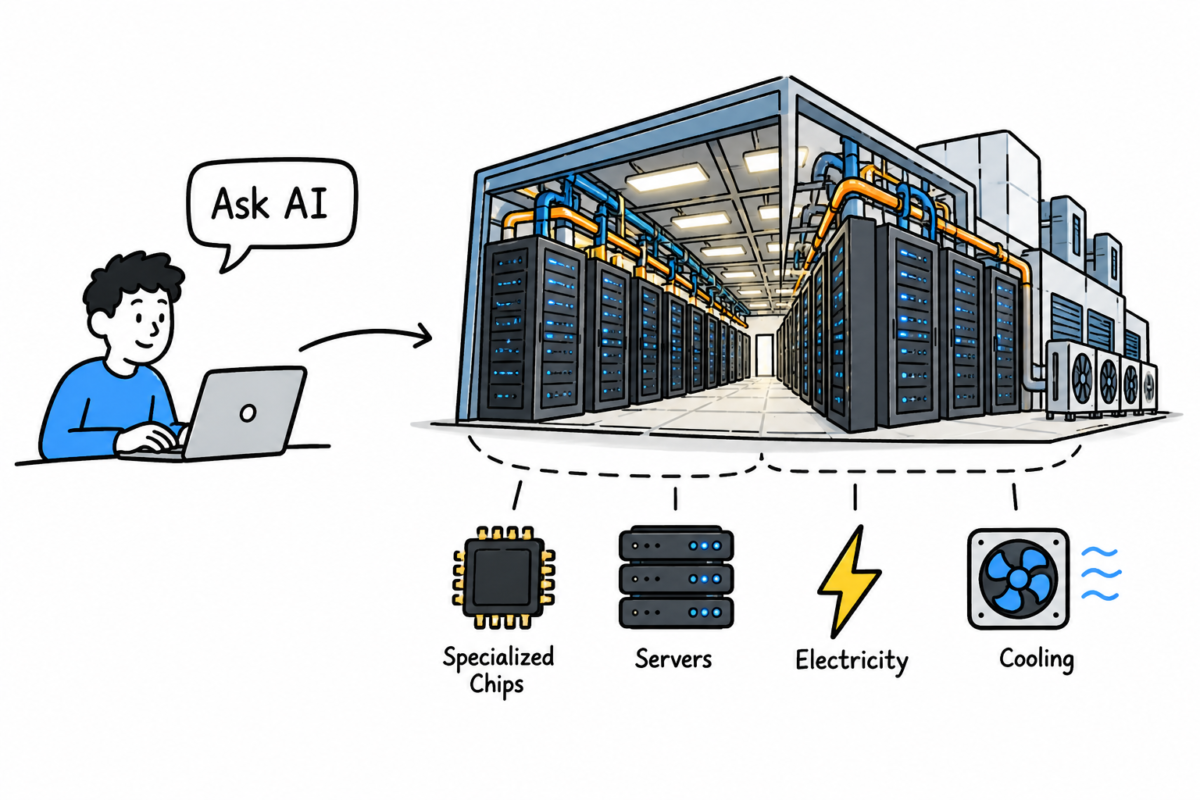
But behind that simple interaction is an enormous physical system involving specialized computer chips, massive data centers, electricity, cooling equipment and billions of dollars in investment. The hidden cost of AI is much bigger than the monthly subscription you might pay to use it.
And here is the part that makes this story especially interesting: even as AI companies work to make their models faster and cheaper, the infrastructure required to run them is becoming one of the biggest challenges facing the technology industry.
So who is actually paying for all these AI answers, what does it take to keep the machines running, and could the cost of the AI boom eventually become a problem for the companies building it?
Your AI Answer Looks Free. But Someone Is Paying for It.
Open a free AI chatbot and ask it to explain quantum physics, write a business email or summarize a long document. Within seconds, you may have a useful answer without spending a single rupee.
But free to the user does not mean free to operate. Every response requires computing resources, and those resources depend on physical hardware running inside data centers. Someone has to buy the chips, build the facilities, supply the electricity and maintain the systems. This is where the hidden cost of AI begins.
That cost changes depending on the model, the length of the conversation, the complexity of the task and the hardware being used. A short text response is not equivalent to generating a long report, analyzing a large collection of files or creating an image.
The surprising part is that the chatbot is only the visible tip of the business. Underneath it sits a complicated infrastructure operation that users rarely see when they click the send button. Much of the expense behind the hidden cost of AI remains invisible to the person receiving the answer.
Companies can recover these costs through subscriptions, business contracts, API usage fees and other products. Some also treat free access as a way to attract users who may eventually become paying customers.
That means the real question is not whether AI costs money. It is whether the revenue generated by AI products will eventually justify the enormous expense of building and operating them.
The AI Gold Rush Is Building Something Enormous
The race to build better AI models has triggered a massive investment push across the technology industry. Major cloud providers and AI companies are spending on data centers, computing equipment and the power infrastructure needed to support increasingly demanding workloads.
The International Energy Agency has examined how the expansion of AI and data centers could affect electricity demand, infrastructure planning and energy markets. Its analysis highlights a challenge that goes beyond software: AI growth depends on real-world infrastructure that takes time and money to build.
Building a modern AI data center is not as simple as renting an office and filling it with computers. Operators need reliable electricity connections, networking equipment, backup systems, cooling technology and specialized facilities designed to run large computing workloads continuously.
They also have to plan for future demand. A facility designed around today’s workloads may not be sufficient for the next generation of AI systems, especially as companies experiment with reasoning models, autonomous agents and increasingly complex applications.
This is where the hidden cost of AI starts becoming easier to understand. The price of a chatbot is only one small part of a much larger investment cycle involving construction, equipment, electricity and long-term operations.
The scale of this infrastructure race also helps explain why chipmakers such as NVIDIA have become so important to the AI industry. Advanced processors are not merely components inside a computer. They are essential tools for training and running many of today’s most capable AI systems.
For a closer look at how specialized hardware is evolving, read our coverage of Mistral Large 4 and its massive AI architecture. The model layer may get the headlines, but the hardware underneath it helps determine what companies can actually deliver.
And hardware is only one part of the equation. The hidden cost of AI also includes the facilities, electricity and technical systems required to keep those processors running reliably.
The Electricity Problem Is Getting Harder to Ignore
Computing requires electricity, and large AI workloads can require substantial amounts of it. When thousands of processors operate together inside a data center, the facility needs a dependable supply of power not only to run the machines but also to support networking, cooling and other equipment.
The challenge becomes more complicated when data centers expand faster than local electricity infrastructure. New facilities may need upgraded transmission lines, additional generation capacity and improvements to the grid before they can operate at their intended scale.
According to the International Energy Agency, data centers are becoming an increasingly important part of the global electricity conversation. Its report, Energy and AI, examines the relationship between AI development, data-center demand and the energy systems required to support them.
However, it is important to separate total data-center electricity consumption from the portion specifically attributable to AI. Data centers also support cloud computing, websites, video streaming, enterprise software and many other digital services. The exact AI share depends on how the workloads and facilities are measured.
For the companies operating these facilities, electricity is not just an environmental consideration. It is an operating expense that can influence where data centers are built, which hardware they use and how efficiently their models need to run. This makes energy a major part of the hidden cost of AI.
Cheap computing is difficult to deliver when the electricity and infrastructure behind it are expensive. That is why energy efficiency is becoming a competitive issue for AI developers, not simply a sustainability talking point.
The Machines Need Cooling, Too
There is another physical problem hiding behind every AI response: heat. Powerful processors consume electricity while performing calculations, and much of that energy eventually becomes heat that the data center must remove.
Ordinary computing facilities already need cooling systems, but high-density AI hardware can make the challenge more demanding. When large numbers of processors operate close together, removing heat efficiently becomes essential to maintaining performance and avoiding equipment problems.
Depending on the facility and hardware, operators may use carefully engineered airflow, liquid cooling or combinations of different cooling technologies. These systems add equipment, installation requirements, maintenance and additional energy use.
Cooling can also affect how a facility is designed. Rack layouts, plumbing, power distribution and the physical space around equipment all influence how efficiently the building can operate.
That is why the cost of running AI cannot be calculated by looking at the processor alone. The full system includes the supporting infrastructure that allows those processors to work reliably around the clock. These requirements add another layer to the hidden cost of AI.
There is a further complication: water use. Some data centers rely on water-based cooling systems, while others use different approaches. The amount of water consumed varies with cooling design, climate, local conditions and how the facility is operated.
As AI infrastructure expands, communities and operators will have to consider these local trade-offs rather than treating every data center as if it has the same environmental footprint.
The Chip Race Is Bigger Than NVIDIA
When people discuss AI hardware, NVIDIA often dominates the conversation. Its processors are widely used for demanding AI workloads, but the wider industry is exploring several approaches to improving performance and controlling costs.
Other chipmakers are developing competing accelerators, while major cloud providers are designing their own processors for particular workloads. Google’s Tensor Processing Units, for example, are designed to accelerate machine-learning computations within its infrastructure.
You can learn more about Google’s approach through its official Tensor Processing Unit documentation. The broader point is that AI computing does not depend on one universal chip. Different processors can be better suited to different tasks, software environments and performance requirements.
But developing advanced chips is expensive in its own right. Companies must invest in chip design, software support, manufacturing capacity and the engineering needed to make their hardware useful to developers.
Even buying the hardware is only the beginning. AI operators must also consider how many processors they need, how well those processors work together, how much memory is available and how efficiently their software uses the system.
This is one reason software optimization matters so much. Better algorithms and more efficient models can sometimes deliver useful results with fewer computing resources, reducing pressure on hardware budgets and operating costs.
The AI race is not simply about building the biggest model. It is also about delivering useful results at a cost that customers and businesses are willing to pay. The companies that manage the hidden cost of AI most effectively could have an important advantage.
Making AI Cheaper Could Create an Even Bigger Bill
At first glance, making AI more efficient sounds like a straightforward win. If a model can answer questions using fewer computing resources, companies may be able to lower their costs, improve response times or serve more users with the same infrastructure.
But there is a twist. When a technology becomes cheaper to use, people often find more ways to use it. Businesses may move from occasional chatbot questions to automated customer support, document processing, software development and large numbers of AI-powered workflows.
AI agents could add another layer to this change. Rather than responding to a single prompt, an agent may search for information, call tools, inspect results and repeat the process several times before completing a task.
Our coverage of NVIDIA’s AI agent safety platform explores another challenge created by this shift: as AI systems become more capable of taking actions, controlling what they can access and do becomes increasingly important.
A complex task involving multiple steps can require far more computing than a short question. If millions of people and businesses begin running these workflows continuously, the total demand for computing could rise even when the cost of each individual operation falls.
This does not mean efficiency improvements are pointless. They remain essential. It means that lower costs per task do not automatically guarantee lower total spending across the entire industry.
The paradox is simple: cheaper AI can make AI useful in more places, and that wider adoption can increase the total amount of computing required.
Who Is Actually Paying the Hidden Cost of AI?
There is no single answer because the cost is spread across several groups. AI companies pay to develop and operate models. Cloud providers invest in data centers and computing equipment. Businesses pay for API access, subscriptions or infrastructure of their own.
Consumers may contribute through paid subscriptions, products that incorporate AI features or services whose prices reflect the cost of running AI behind the scenes. In some cases, free access is supported by other business revenue or treated as an investment in attracting future customers.
Investors also play a role. When companies raise money or use available capital to expand their AI infrastructure, they are effectively financing the expectation that future demand and revenue will justify today’s spending.
That expectation creates risk. Building facilities and purchasing specialized equipment can require large commitments before the final returns are clear. If demand grows more slowly than expected, companies could find themselves with expensive infrastructure that is not being used as intensively as planned.
There are also local effects. Communities hosting large data centers may experience changes in electricity demand, infrastructure requirements, land use and, depending on the facility, water consumption. The scale of these effects varies considerably from one location to another.
None of this means that AI infrastructure is inherently a bad investment. It means that the benefits and costs are distributed across companies, customers, investors and communities, and those groups may not experience the same outcomes.
The real question is whether the productivity gains and new products enabled by AI will be valuable enough to cover the costs of building and operating the systems behind them. Ultimately, that is what will determine whether the hidden cost of AI can be justified by the value it creates.
The Bigger Question Is Whether the AI Boom Can Pay for Itself
The technology industry has experienced major infrastructure cycles before. Companies have invested heavily in networks, cloud platforms and computing systems because they expected demand to grow over time. AI is creating another investment cycle, but the scale and speed of the buildout have made the economics especially important.
For AI businesses, success will depend on more than attracting users. They need products that solve real problems, customers who are willing to pay and operating systems that can deliver results efficiently enough to support sustainable margins.
Enterprise contracts and paid subscriptions can generate revenue, while more efficient models and specialized hardware may reduce the cost of delivering AI services. Some companies may also benefit by incorporating AI into products and services they already sell.
Still, not every AI product will become a profitable business. Some services may struggle to cover their computing expenses, while others may face strong competition that pushes prices down. A large user base does not automatically translate into healthy economics.
There is also a difference between the long-term value of AI and the short-term financial returns on the infrastructure being built today. A technology can eventually transform an industry without every company or investment connected to it becoming successful.
That is why it is worth looking beyond impressive model demonstrations and user growth figures. The more revealing questions concern the cost of serving customers, the revenue generated by those services, the utilization of computing infrastructure and the energy required to keep everything running.
The AI boom does not need to stop growing, but its economics will eventually have to make sense. The future of the industry may depend as much on controlling infrastructure expenses as it does on building more capable models.
The Bottom Line
The next time an AI chatbot gives you a detailed answer in seconds, remember that the experience is supported by a much larger system. Specialized chips perform the calculations, data centers house the machines, electricity keeps them running and cooling systems remove the heat they generate.
Developing and operating that infrastructure requires investment, and the bill is shared across AI companies, cloud providers, customers, investors and the communities where data centers are built.
At the same time, more efficient models, better hardware and smarter software could help reduce the cost of delivering AI. Those improvements may also make new applications affordable, potentially expanding the number of people and businesses using the technology.
That creates the central tension behind the hidden cost of AI. The technology could become cheaper and more useful, but its growing popularity could also drive demand for more computing, electricity and infrastructure.
Whether the AI boom succeeds financially will depend on how well companies balance those forces. The most capable model is not necessarily the most successful product, and the most impressive demonstration is not necessarily the most sustainable business.
AI may look like software on your screen, but its future will also be shaped by power stations, semiconductor factories, data centers and the economics of running them.
The answer may feel free. The infrastructure behind it is not.