


90 AI agents just spent three days searching for something that could change the way future computers store information.
And then they found something strange. One of their most interesting candidates was not some mysterious material buried in a laboratory. It was a compound that humans had already made 27 years ago.
The material had been sitting in the scientific record since 1999. What the AI researchers noticed was that it may have a combination of properties that could make it useful for a very different kind of computer memory.
That does not mean 90 AI agents just invented the next computer chip. They did not. Neither candidate has been experimentally proven for the properties the researchers are interested in.
But what happened next is arguably much more interesting.
More than 90 Claude Opus 5.5 agents searched, simulated, challenged and re-checked the possibilities for roughly three days. In the process, the system produced two computational candidates that human scientists can now take into the laboratory.
This is not really a story about an AI chatbot giving scientists an answer. It is a story about what happens when 90 AI agents are given a scientific problem and enough tools to keep investigating it.
AI Wasn’t Asked to Write a Paper. It Was Asked to Find Something.
The project came from Vals AI, where a team of Claude Opus 5.5 agents was given a very specific scientific target: find a material that could combine semiconductor behavior with a useful kind of magnetism at around room temperature.
That sounds incredibly niche until you understand why researchers care. Future computing systems may be able to use the spin of electrons, rather than relying only on their electrical charge, to store and manipulate information. This field, known as spintronics, already has real applications, including magnetic storage and MRAM.
The catch is that ordinary magnetic materials can create unwanted magnetic fields around them. For dense computing hardware, that kind of interference can become a serious problem. The researchers were therefore looking for something unusual: a material whose overall magnetism can effectively cancel out while its electrons still retain useful spin-selective behavior.
That is the basic idea behind a Luttinger-compensated magnet. And instead of asking one AI model to suggest a few materials, the researchers turned the problem into a large agent-driven search.
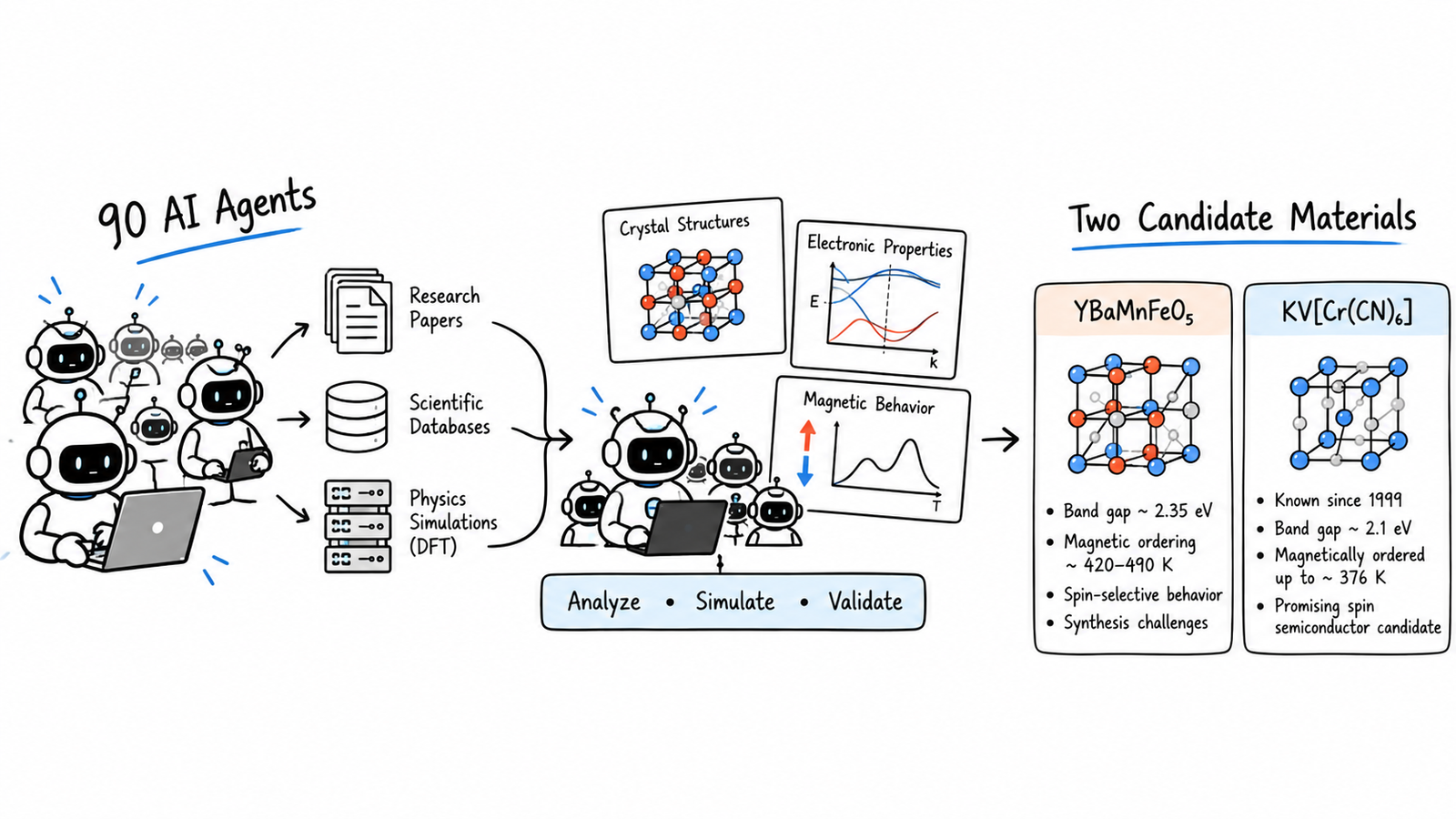
The agents explored different research lanes, ran density functional theory calculations, searched scientific literature and then used additional agents to challenge surviving results. The relevant search lane submitted roughly 750 computational jobs, with the public research ledger documenting the inputs, outputs, scripts and corrections.
You can inspect the underlying calculations and evidence in the public computational ledger on GitHub.
That workflow is important because it shows what 90 AI agents were actually doing. They were not simply generating a list of ideas. They were searching, testing, rejecting and revisiting possibilities across multiple stages of the investigation.
The First Candidate Was New. And It Immediately Hit a Wall.
The first candidate was YBaMnFeO5, a material design created during the search. On a computer screen, it looked surprisingly good. The simulations predicted a band gap of about 2.35 eV, with spin-selective energy windows of roughly 1.0 eV for holes and 1.4 eV for electrons.
The calculations also suggested magnetic ordering above room temperature, with a raw estimate around 420 K and a calibrated estimate closer to 490 K. In other words, if the simulated material could actually be produced in the required structure, the basic numbers looked promising.
Then the agents started trying to break their own result.
The useful behavior depends on manganese and iron atoms forming a very specific ordered pattern inside the crystal. The follow-up calculations suggested that this arrangement could start scrambling at around 950 K, while making comparable oxide materials can require temperatures around 900°C to 1,300°C.
That creates a nasty manufacturing problem. The heat needed to make the material could potentially destroy the very atomic arrangement that gives it the interesting electronic behavior.
So the AI team’s own review did not call it a breakthrough. It classified the candidate as a design study rather than a realizable discovery.
And honestly, that is one of the most interesting parts of the whole experiment.
The 90 AI agents were not rewarded for finding something that sounded impressive. They were also used to attack the result and figure out why it might fail.
Then AI Found Something Humans Had Made in 1999
This is where the story suddenly gets much more interesting.
The second candidate is KV[Cr(CN)6]. The formula is not exactly going to make anyone’s phone light up with excitement, but the story behind it might.
Scientists had already synthesized the compound in 1999. It belongs to the broader family of Prussian-blue-type materials, and the original sample was already known to remain magnetically ordered at surprisingly high temperatures.
What the new AI-assisted analysis suggested is that this old material may also have the electronic structure needed for the specific type of spin-selective semiconductor behavior the researchers were searching for.
That distinction matters.
The AI did not invent the material. It connected an old material with a new question.
The 1999 sample was reported to remain magnetically ordered up to about 376 K, or roughly 103°C. The new calculations put its band gap at around 2.1 eV and predicted large spin-selective windows near the band edges.
There is also a fascinating historical twist. A 2008 hybrid-functional study had already shown electronic features consistent with the relevant spin behavior, but it did not identify the compound as the particular type of compensated semiconductor the new work was looking for.
So the contribution from 90 AI agents looks less like inventing and more like connecting dots that had been sitting in different parts of science for years.
The original research and its detailed caveats are available in the Vals AI research report.
Why Would Anyone Care About a 27-Year-Old Compound?
Because if the predictions survive laboratory testing, researchers would not have to start from zero.
That is a huge difference. A completely new material has to survive an entire chain of questions before it becomes useful: can it be synthesized, does it form the predicted structure, is it stable, does it behave the way simulations predicted, and can it eventually be manufactured reliably?
KV[Cr(CN)6] has already crossed at least one of those hurdles. Humans have made it before. That does not prove it works as a spin-selective semiconductor, but it gives researchers a real material they can go back to and test.
And that is where the potential computing story comes in.
If a material can cancel its overall magnetic moment while still sorting electrons by spin, it could potentially offer some of the useful behavior of magnetic computing without producing the same kind of stray magnetic fields associated with ordinary ferromagnets.
That could matter for future memory technologies where engineers want magnetic information without unwanted interference between neighboring components.
But there is a very important word here:
Potentially.
Nobody has yet experimentally measured the predicted spin polarization, conductivity or band gap for this material in the exact way needed to prove the computational claim.
This Is What Makes the 90-Agent Experiment So Strange
Normally, when people hear that AI discovered something, they imagine a model producing an answer in a few seconds. That is not what happened here. The agents were effectively given a research objective and access to the computational tools needed to investigate it.
Some agents searched literature. Others explored candidate materials. Others ran calculations. Others acted like skeptical referees, trying to find reasons the surviving claims were wrong. The system even recorded corrections and failed paths instead of quietly hiding them.
That starts to look less like a chatbot and more like a strange new kind of research organization.
And that distinction is important because science has a search problem.
There are millions of compounds, thousands of scientific papers and an enormous number of possible combinations of structures and properties. Human researchers can be extremely good at deciding what matters, but they cannot investigate every possibility.
An AI system can at least attempt to search much more of that space.
That does not make the AI automatically right. It makes the machine useful in a different way: it can explore possibilities that humans may never have had the time to explore.
We have already seen this broader agent shift in our coverage of AI agents finding their own ways through the internet. Here, the same basic idea is being pointed at scientific discovery instead of cybersecurity.
And the Agents Were Actually Trying to Prove Themselves Wrong
This part deserves more attention than it is getting.
The research was not simply a giant AI brainstorming session where every interesting prediction became a headline. The system included adversarial review, with agents attempting to challenge the surviving claims through additional calculations and literature checks.
The public ledger currently maps 61 reported claims to their supporting evidence. Most were recomputed directly from raw simulation outputs, while others were reproduced through scripts or traced back to experimental and literature sources.
The project also documents corrections made during the work, including issues involving a stability calculation, a convergence problem, a truncated output and previously missed prior research.
That is important because scientific AI cannot simply be judged by how impressive its final answer sounds.
The real test is whether someone else can check it.
In this case, much of the underlying work is public, which gives other researchers a way to reproduce the calculations and attack the conclusions.
That is a much healthier model for AI-assisted science than simply saying, “the AI discovered it, trust us.”
But No, AI Has Not Solved the Materials Problem Yet
This is where the hype needs to slow down.
Both candidates are still computational predictions. Neither has been experimentally validated for the specific electronic properties that make them interesting.
The first candidate has an obvious synthesis problem. The second candidate has an existing sample, but that sample was a hydrated powder, and the researchers’ computational methods disagree about how strongly water affects the predicted behavior.
There is also a broader issue. A material can look perfect in a simulation and become much less impressive once defects, impurities, temperature, manufacturing conditions and other real-world complications enter the picture.
So the next step is not another AI benchmark.
It is a laboratory.
Researchers would need to make fresh samples, verify their structures, measure their magnetic behavior and directly test whether the electrons really show the predicted spin sorting.
That is where the computer-generated hypothesis either becomes a scientific result or disappears.
The independent analysis from The Ruling Desk similarly emphasizes that these are predictions rather than laboratory discoveries and highlights the unresolved experimental questions.
The Bigger Breakthrough May Not Be the Material
Here is where this story gets much bigger than spintronics.
For years, we have measured AI progress by asking whether a model can answer questions better than another model. Then we started asking whether agents could use tools, browse the internet and write software.
Now we are beginning to see another possibility: AI systems that can run entire research loops.
Give the system a goal. Let it search the literature. Let it generate hypotheses. Let it run simulations. Let another set of agents attack those hypotheses. Then hand the strongest surviving ideas to human researchers.
That workflow could eventually apply to batteries, medicines, catalysts, superconductors, semiconductor materials and hundreds of other fields where the search space is simply too large for humans to explore manually.
It is also part of a much wider shift in what AI systems are becoming capable of. From autonomous internet activity to systems designed to operate safely inside real environments, the agent is increasingly moving beyond the traditional chatbot model.
Our coverage of NVIDIA’s safety wall for AI agents explored the control problem that comes with this shift, while our story on Apple changing the rules for AI agents on the Mac showed how quickly these systems are moving into everyday computing environments.
Here, the same underlying technology is being pointed somewhere completely different.
Science.
The agent is no longer just waiting for a question.
It is being given a problem.
The 1999 Discovery Is the Part I Can’t Stop Thinking About
There is something almost poetic about the second candidate.
Scientists made the compound in 1999. A later study even contained clues about its electronic behavior. And yet the particular connection that the new AI search was looking for apparently went unnoticed.
Then, more than two decades later, an army of 90 AI agents came along with a very specific question and looked at the old material from a completely different angle.
That may be one of the most powerful things AI can do for science.
Not necessarily invent something nobody has ever seen.
Sometimes it may simply make us look again at what we already have.
Science has accumulated an enormous archive of experiments, measurements and materials. Much of that knowledge was created before today’s computational tools existed. There could be valuable connections buried inside it that nobody had a reason to search for until now.
AI is exceptionally well suited to that kind of cross-connection.
So, Did 90 AI Agents Actually Discover Something?
They found two promising computational candidates, but calling them confirmed discoveries would be premature.
YBaMnFeO5 is a newly designed candidate that looks impressive in simulations but may be extremely difficult to manufacture without destroying the atomic arrangement it needs. KV[Cr(CN)6] is the more surprising case: a material made back in 1999 that the new analysis suggests deserves another look as a potential spin-selective semiconductor.
The important part is that the AI system did not stop at generating ideas. It ran calculations, searched prior work, challenged its own conclusions and published a trail that other researchers can inspect.
That turns the story from “AI said something clever” into something much more useful:
Here is a scientific hypothesis. Go test it.
And that may be the real shift happening here. The significance of 90 AI agents is not that they have replaced scientists. It is that they demonstrated how an AI research team can search, test and challenge possibilities before handing the strongest candidates back to humans.
The Bottom Line
90 AI agents did not just discover a magical new material that is about to transform your laptop.
Reality is much more interesting than that.
They were given a difficult materials-science problem and spent roughly three days searching through simulations, literature and competing hypotheses. One candidate was newly designed. The other was a 27-year-old compound that had already been sitting in the scientific record.
Neither has been proven in the laboratory for the exact properties researchers care about. There are still major questions about synthesis, defects, hydration, measurements and whether the predicted electronic behavior survives outside a computer.
But that almost misses the point.
The fascinating part is that an AI research team can now search through possibilities at a scale that would be extremely difficult for a human team to cover manually.
It can search old papers. Run simulations. Generate candidates. Kill bad ideas. Revisit forgotten materials. And keep going.
Maybe the next major scientific breakthrough will be something completely new.
Or maybe it has already been discovered.
Maybe it is sitting inside a 20-year-old paper, waiting for a machine to ask the right question.
That is the part that should make scientists pay attention.
Because AI may not need to know everything to change scientific discovery.
It may just need to be willing to keep looking.