

Elon Musk has turned Starlink’s India delay into a public fight, and now Mukesh Ambani is at the centre of the storm.
After years of waiting to launch its satellite internet service in India, Musk has started questioning why Starlink still cannot begin commercial operations. Then he took the argument a step further, publicly questioning Ambani’s influence and turning a complicated telecom dispute into a showdown that has captured attention far beyond the technology industry.
It is the kind of clash that almost writes its own headline: the world’s most outspoken tech billionaire against one of India’s most powerful business figures. But the real story behind the Starlink India delay is not quite as simple as it looks.
Starlink has obtained a licence to operate in India, yet it still needs to satisfy outstanding requirements before it can launch commercially. Musk has accused powerful interests of obstructing the company, while India’s government has rejected suggestions that its satellite internet approval process is unfair.
So is Starlink being blocked by a competitor, caught in a slow regulatory process, or facing a mixture of challenges? And what does the dispute mean for millions of Indians who may eventually want another option for internet access?
The answers reveal a much bigger battle over satellite internet in India, spectrum allocation, competition and who gets to connect the country’s next wave of internet users.
Elon Musk vs Mukesh Ambani: How the Starlink India Fight Escalated
The latest Starlink India news began with Musk accusing unnamed powerful business interests of trying to prevent the satellite internet service from entering the Indian market. His argument was that established players had an incentive to protect their existing businesses from a new competitor.
On October 8, Musk turned the dispute directly toward Mukesh Ambani, questioning whether the Reliance Industries chairman held excessive influence over India’s decisions. The remark quickly shifted the conversation from a delayed technology launch to a much broader debate about business power and competition.
There is an obvious reason Ambani’s name matters here. Reliance Jio has built one of India’s largest telecom businesses, while Starlink wants to introduce a different kind of connectivity through SpaceX’s satellite network. Both companies have interests in a market where the next generation of internet infrastructure could be extremely valuable.
But there is a crucial distinction between a possible commercial conflict and evidence of deliberate obstruction. Musk has not publicly established that Ambani or Reliance Jio caused Starlink’s delayed launch. His accusation remains an allegation, not a proven explanation for the regulatory situation.
That distinction can disappear quickly on social media. A complicated approval process becomes a story about two billionaires, and every delay starts looking like evidence of a hidden fight. The actual facts require a closer look at the licences, security conditions and spectrum rules governing satellite communications in India.
TechCrunch’s report on Musk questioning Ambani’s influence provides more background on the public dispute and the competing satellite internet interests in India.
India Responds: Is Starlink Being Treated Unfairly?
India’s government has pushed back against Musk’s claims. On October 9, Telecom Minister Jyotiraditya Scindia said India does not permit monopolies in any sector, rejecting the implication that the Starlink India launch was being held back to protect a powerful incumbent.
The government has also said that Starlink and two other licensed satellite operators are at broadly the same stage of the regulatory process. They still need to meet the remaining security requirements and obtain spectrum assignment before commercial services can begin.
This response challenges the central idea behind Musk’s public criticism. If operators are subject to comparable requirements, a delay alone does not establish that a competitor has influenced the process.
That does not mean questions about the speed or transparency of regulation are unreasonable. Businesses need predictable timelines, and customers want to know when a new service will actually become available. But proving that a process is slow is different from proving that a rival deliberately caused the delay.
For now, the public record supports a more careful conclusion: Musk has questioned the fairness of the process, the government has rejected that accusation, and Starlink still has regulatory steps to complete before it can begin commercial operations in India.
Read Reuters’ October 9 report on India’s response to the Starlink controversy for the latest statements from the government and details of the dispute.
Is Starlink Banned in India? Here Is What Actually Happened
No. The claim that Starlink has been banned in India would misrepresent the current situation.
Starlink has obtained a licence to operate in India, but a licence is not the same as permission to start commercial service immediately. The company still needs to meet outstanding conditions, including security compliance, and receive the relevant spectrum assignment.
Think of the process as several gates rather than a single approval. An operator may receive authorisation to provide a category of service but still need to satisfy technical, security and spectrum-related requirements before switching on a commercial network.
Satellite internet is not simply another app entering the Indian market. It depends on communications infrastructure that crosses borders, uses radio frequencies and must operate under the country’s legal and security framework. Those requirements are part of how India manages satellite communications.
The Department of Telecommunications explains the framework on its official GMPCS satellite service page. Its guidance states that a licence does not automatically confer the right to use spectrum; a separate frequency assignment is required.
That detail helps explain why the Starlink India launch date remains uncertain. Even after an important licence is secured, the operator must complete the other applicable steps. The remaining process cannot be reduced to a simple yes-or-no decision about whether India wants Starlink.
So the more accurate question is not whether Starlink has been banned, but why the final conditions have not yet been completed and when the company will be cleared to begin commercial service.
Why Ambani, Jio and Airtel Matter to Starlink’s India Launch
India is one of the world’s largest internet markets. Reliance Jio and Bharti Airtel have enormous existing customer bases, established networks and experience delivering connectivity across the country. A new satellite operator would enter a market where these companies already have significant commercial interests.
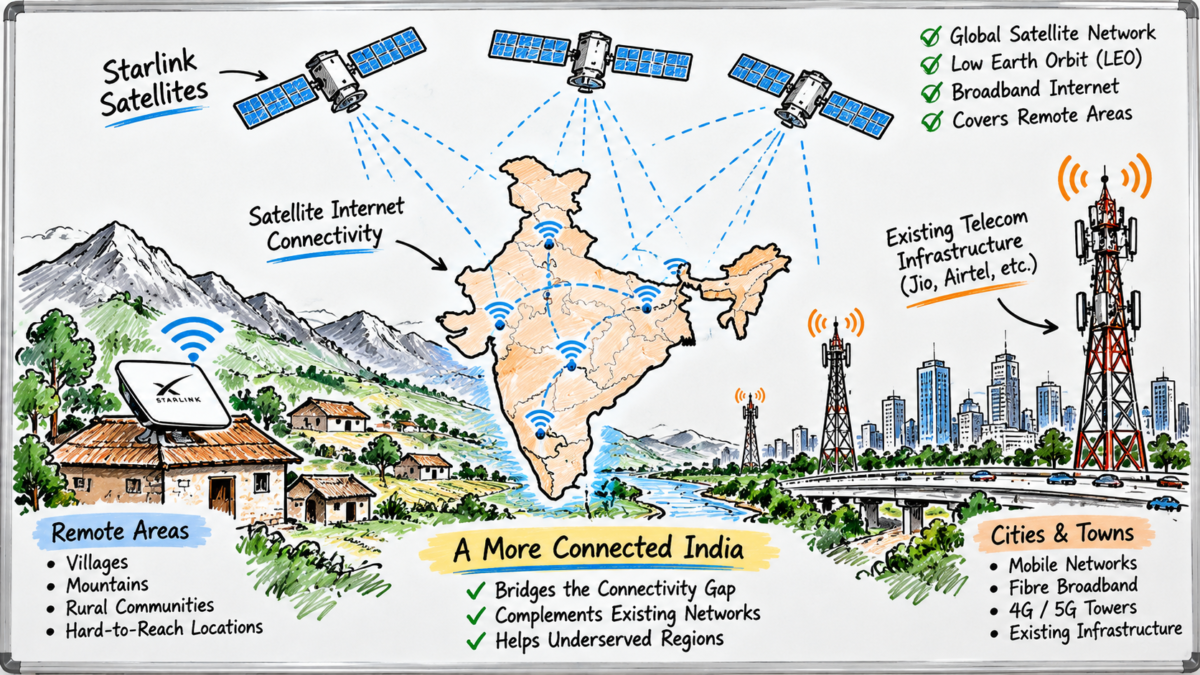
Starlink’s technology is different from traditional mobile broadband. Its network uses satellites in low Earth orbit to deliver internet connectivity through compatible equipment on the ground. That can make it useful in locations where fibre deployment is expensive or where building conventional infrastructure is difficult.
But satellite internet is not automatically a replacement for every fibre connection or mobile tower. Service costs, equipment, coverage, capacity and local conditions all affect whether it makes sense for a customer.
The competitive overlap is nevertheless real. Jio has interests in satellite connectivity, while Airtel is connected to OneWeb, another satellite operator. Starlink would add another major player to a market where companies are positioning themselves for future demand.
That makes the Elon Musk vs Mukesh Ambani angle commercially interesting, but it does not prove that either company has acted improperly. Rivalry can explain why the outcome matters to each business without establishing that a rival is responsible for a regulatory delay.
We have covered similar shifts in the technology industry, including Amazon’s unexpected change to its tablet strategy. In both cases, the interesting question is how a major company tries to enter or reshape a market where established products already have a strong position.
The Real Roadblock: Spectrum Allocation and Security Compliance
Two phrases keep appearing in the Starlink India delay story: spectrum allocation and security compliance. They may sound like technical details, but they help explain why a commercial launch cannot happen simply because a company says it is ready.
Spectrum allocation concerns the radio frequencies a communications service can use and the conditions attached to that use. Satellite networks need appropriate frequency assignments and coordination to operate within the rules. A service licence by itself does not automatically grant permission to use every frequency required for commercial operations.
Security compliance concerns the conditions an operator must satisfy to run a communications service under India’s rules. The precise requirements depend on the applicable authorisation and regulatory conditions, but the broader point is that a satellite operator must meet its obligations before it can begin service.
These requirements are not unique to Starlink. The government has said the licensed satellite operators are at broadly the same stage. That is why the outstanding approvals matter more than assumptions about a single company blocking another.
Starlink has argued that it has spent years preparing for India and is ready to serve customers. From the company’s perspective, the continuing wait raises questions about timing and regulatory clarity. From the government’s perspective, the required conditions still need to be fulfilled.
Until the authorities confirm that the remaining steps have been completed, a firm Starlink India launch date should not be treated as guaranteed.
Could Starlink Change Internet Access in India?
The potential is real, especially for customers who struggle to get reliable connectivity. Satellite internet can provide another route to broadband in remote communities, isolated work sites and locations where extending fibre or building conventional infrastructure is difficult.
For businesses, satellite connectivity can also be useful as a backup or as a way to connect facilities far from existing networks. The value depends on the service’s reliability, available capacity, equipment requirements and total cost.
Urban users already served by competitive fibre broadband may have less reason to switch. For them, the decision will depend on pricing, performance and the alternatives available at their address. Satellite internet is a different option, not an automatic upgrade for every household.
There are practical limitations, too. Customers need compatible equipment, adequate power and a suitable installation location. Performance can vary with network conditions and the environment, and equipment costs may make the service less attractive to some users.
That is why the Indian launch matters. Until Starlink publishes the relevant local service details and customers can evaluate the actual offer, claims about what it will cost or how it will compare with existing providers remain speculative.
The wider technology industry is changing quickly as companies bring new services to market. Our coverage of Apple’s changes to AI agent security on the Mac is another example of how a product launch can raise questions about control, access and the rules that govern a new technology.
What Happens Next in the Starlink India Delay?
There are three developments worth watching if you want to follow the Starlink India news beyond the social media argument.
First, the remaining approvals. A formal update confirming that security conditions have been met and spectrum has been assigned would be a meaningful step toward commercial service. Until then, a launch date remains uncertain.
Second, the government’s explanation. More detail about the outstanding requirements, the process and the next milestones would help customers and businesses understand what remains unresolved. Clearer timelines would also help distinguish an ordinary regulatory delay from claims of unfair treatment.
Third, what the companies say and do. Musk has made public allegations, while the government has rejected the suggestion that the approval framework is discriminatory. Any concrete evidence or official decision would carry more weight than another round of online speculation.
The next chapter may be another public exchange, but it may also be a straightforward regulatory announcement. Either way, the key question is whether Starlink completes the requirements necessary to begin commercial operations in India.
The dispute also highlights a broader issue for India’s satellite internet policy: how to attract new technology providers while applying licensing, security and spectrum rules consistently. That balance will matter well beyond a single company.
The Bottom Line
Elon Musk has pulled Mukesh Ambani into a public dispute over the Starlink India delay, turning a long-running regulatory wait into a headline-grabbing clash. The government has rejected the suggestion that its satellite internet approval process is unfair and says licensed operators are at broadly the same stage.
Starlink has not been banned in India. It has obtained a licence, but security compliance and spectrum assignment remain important requirements before commercial service can begin. The launch date is still uncertain.
Musk’s allegation has intensified scrutiny of the process, but it has not established that Ambani or Reliance Jio caused the delay. That claim needs evidence, not just a provocative social media post.
For Indian users, the most important outcome is not which billionaire wins the online argument. It is whether the remaining approvals are completed, what Starlink eventually charges, and whether satellite internet becomes a useful additional option for people who need reliable connectivity.
The showdown is public. The launch is still pending. And the next official decision matters more than the noise.
For continuing coverage of autonomous technology and its wider effects, read our reports on AI agents probing the internet and NVIDIA’s AI agent safety platform.