


Amazon just did something that would have sounded almost impossible a few years ago.
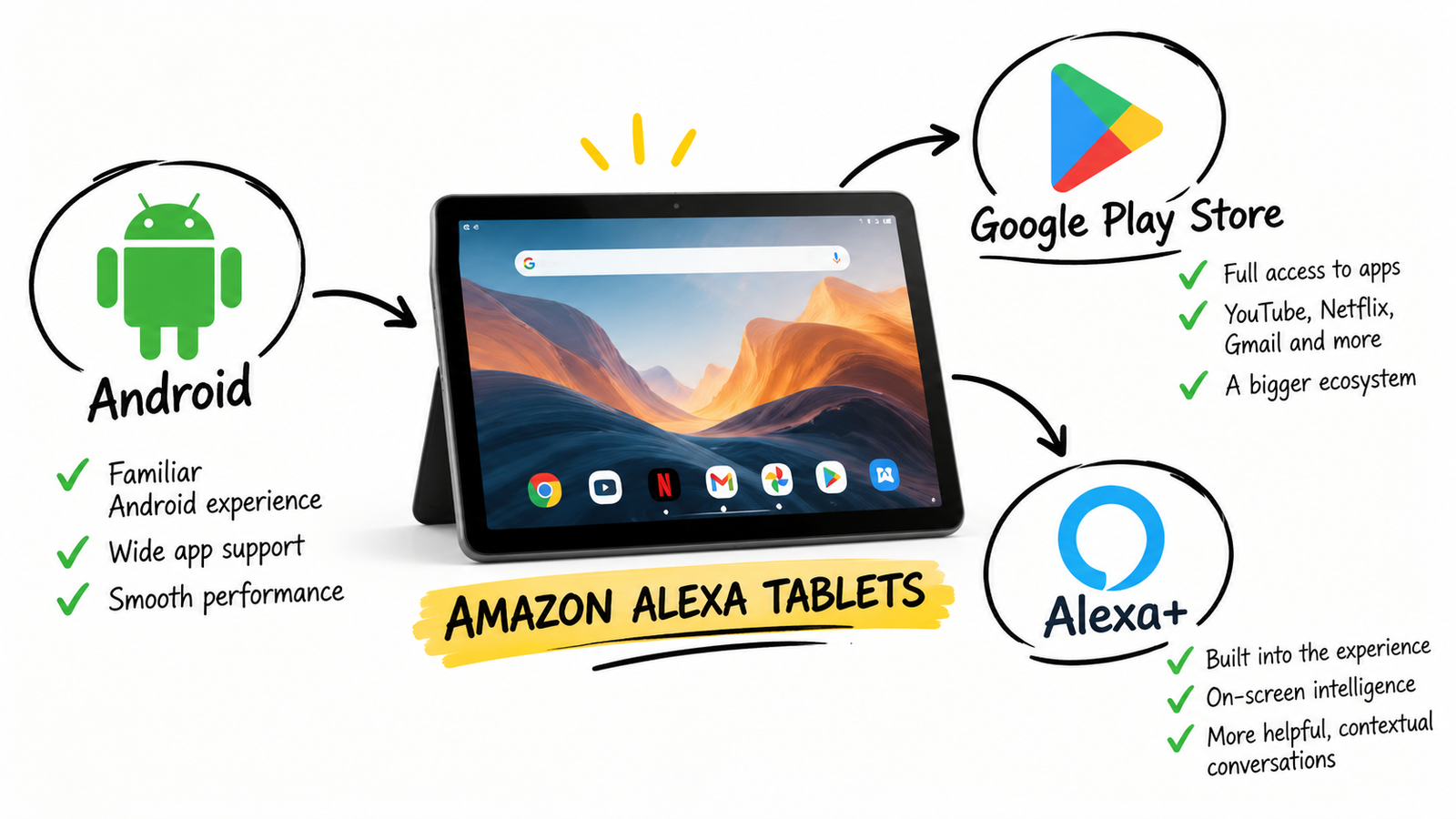
The company that built its tablet business around cheap Fire devices, its own Fire OS and the Amazon Appstore has suddenly changed direction. Its newest Amazon Alexa Tablets run Android, come with full access to the Google Play Store, and put Amazon’s generative AI assistant, Alexa+, right at the center of the experience.
That might sound like a normal product upgrade until you look at what Amazon is actually giving up. For years, Fire tablets were built around Amazon controlling almost everything about the software experience. Now Amazon is opening the door to Google’s ecosystem while simultaneously trying to make Alexa the thing users interact with across the device.
So why would Amazon suddenly do this?
The answer has less to do with making another tablet and much more to do with changing what Amazon thinks a tablet should be. Amazon’s announcement of the new Alexa Tablets confirms just how dramatic that change really is.
Amazon Alexa Tablets Just Changed the Rules
Amazon has introduced a completely new family of devices called Amazon Alexa Tablets, with three models launching across different price points. There is the high-end Alexa Tablet 12 Pro, the mainstream Alexa Tablet 11 and the smaller Alexa Tablet 8. The lineup starts at $229.99 and reaches $549.99 for the premium Nanomatte version of the 12 Pro.
But the prices are not the most interesting part. The real story is underneath the screen.
These new tablets run Android and have access to the full Google Play Store. That means users can download apps such as YouTube, Netflix, Gmail and Google Docs alongside Amazon’s own apps and services. For anyone who has used a Fire tablet before, that is a massive change because Amazon is no longer asking customers to live inside a smaller, Amazon-controlled app ecosystem.
Amazon is also making it very clear that this is not simply a refreshed Fire tablet. The company describes the Amazon Alexa Tablets as an all-new product line with new hardware, Android and Alexa+ built into the core experience.
In other words, Amazon did not just make the old Fire Tablet a little faster.
It changed the entire formula.
And once you understand what Fire tablets were designed to do, that decision starts looking a lot more deliberate.
The Old Fire Tablet Strategy Had One Big Problem
For years, Amazon’s Fire tablets had a very simple proposition. Give customers an inexpensive tablet, make it good enough for watching Prime Video, reading books, browsing the web and using basic apps, then use Amazon’s ecosystem to keep everything connected.
That strategy worked surprisingly well because Amazon did not need to beat the iPad at everything. It just needed to make the tablet cheap enough that people would buy one for the kitchen, the bedroom, the kids or a long flight without thinking too hard about it.
There was, however, a problem that followed Fire tablets for years.
The software ecosystem was not Android as most people knew it.
Fire OS was based on Android technology, but Amazon’s devices did not offer the normal Google Play experience. That meant some popular apps were unavailable, some services required workarounds, and people who were already comfortable with Android could find the experience unnecessarily restrictive.
That limitation was easier to accept when a Fire tablet cost very little. It becomes a much harder sell when you are asking someone to spend $300, $400 or even $500 on a device.
Amazon appears to have realized exactly that.
Instead of trying to convince customers that they do not need the Google Play Store, Amazon is simply giving it to them. The company’s official product information confirms that the new Amazon Alexa Tablets come with full Google Play Store access, removing one of the biggest limitations associated with the old Fire tablet experience.
That one decision removes one of the biggest reasons people had to look elsewhere.
Then Amazon Added the Part That Explains Everything
If Android is the surprising part of this announcement, Alexa+ is the part that explains where Amazon wants the whole category to go with the Amazon Alexa Tablets.
Amazon is not treating Alexa+ as another app sitting somewhere on the tablet waiting for you to open it. The company has built the assistant directly into the experience, with a personalized home screen, voice and touch access, live conversations and the ability to help with whatever you are doing on the device. Amazon’s Alexa+ experience is designed around more contextual interactions than traditional voice commands.
You can say “Alexa” or tap the Ask Alexa button, and the assistant can answer questions, suggest next steps, control compatible smart-home devices and work with information that is already part of your Amazon experience.
But the more interesting feature is called On-Screen Intelligence.
This allows Alexa+ to look at what is currently displayed on the screen when the feature is enabled and provide help based on that context. Imagine browsing a page filled with hiking trails and asking Alexa which one would be best for you. Instead of manually copying information into a chatbot, the assistant can look at the page, understand what it contains and help you make a decision.
Or imagine opening a sports schedule and asking Alexa to add the relevant dates to your calendar. Amazon says the assistant can handle that kind of contextual task directly.
That is a much bigger idea than simply putting a chatbot inside a tablet.
Amazon is trying to turn Alexa into the layer sitting between you and the things you do on the device.
Amazon Is Suddenly Playing in a Much More Expensive League
There is another clue hiding in the new lineup, and it has nothing to do with software.
Amazon has finally built a tablet that it wants people to take seriously as a premium device.
The Alexa Tablet 12 Pro starts at $499.99, while the Nanomatte version starts at $549.99. It has a 12-inch display with a 120Hz refresh rate, a 3:2 aspect ratio, an aluminum unibody design and a 4nm eight-core processor. It can be configured with up to 16GB of RAM and supports Wi-Fi 6E and Dolby Atmos audio.
Amazon says the 12 Pro delivers nearly three times faster processing and nine times faster graphics performance than any tablet the company has previously shipped. It also promises up to 16 hours of video playback, making this a completely different class of device from the bargain Fire tablets that built Amazon’s reputation in this category.
Amazon even made a keyboard and stylus specifically for the 12 Pro. The Pro Keyboard turns the tablet into a more traditional productivity setup, while the Pro Pen supports pressure sensitivity, tilt detection and wireless charging.
Suddenly, Amazon is not talking about a tablet you buy because it is cheap.
It is talking about a tablet you buy because you actually want it.
That is a very different game.
This Is Amazon’s Answer to the iPad Problem
Amazon has spent years proving that it can sell affordable hardware. The harder problem is convincing someone to choose an Amazon device when they have enough money to buy an iPad or a premium Android tablet from Samsung and other established manufacturers.
That is where this new strategy starts to make sense.
Amazon is removing the software disadvantage by giving users Google Play. It is improving the hardware dramatically. And then it is adding something that it hopes can become the reason people choose Amazon in the first place: Alexa+.
That changes the sales pitch completely.
Instead of telling customers, “Buy this because it is a cheap tablet,” Amazon can now say, “Buy this because it gives you a premium Android tablet with an AI assistant that is deeply connected to your Amazon account, your smart home, your content and your preferences.”
Whether that pitch actually works is another question. But at least Amazon is finally competing on something more interesting than price.
And this is part of a much bigger change happening across consumer technology. We recently covered how Apple is changing the rules for AI agents on the Mac. Amazon is approaching the same broader shift from a completely different direction.
Instead of putting an AI system beside the operating system, Amazon is trying to make the AI assistant part of how you use the device in the first place.
And Amazon Did Not Forget the Cheap Tablet Buyers
Amazon is not abandoning the people who bought Fire tablets because they were affordable. The company is simply giving them a different path into the new ecosystem.
The Alexa Tablet 11 starts at $329.99 and comes with an 11-inch 2.5K display, a 90Hz refresh rate, 8GB of RAM and up to 15 hours of video playback. It uses an aluminum body and includes Dolby Atmos speakers, making it much closer to what people now expect from a mainstream Android tablet.
Then there is the smaller Alexa Tablet 8, starting at $229.99. It has an 8.7-inch display, weighs just 329 grams and is designed to be easier to hold and carry around. Amazon says it can deliver up to 14 hours of video playback.
So Amazon has effectively created three steps.
$229.99 gets you into the ecosystem. The $329.99 model is aimed at mainstream tablet buyers, while the $499.99 and $549.99 versions push Amazon into premium territory.
But the important thing is that all three share the same basic philosophy. They run Android, have Google Play access and put Alexa+ at the center of the experience.
So What Happens to Your Old Fire Tablet?
This is where the headline needs a little clarification.
Amazon has not remotely killed every Fire tablet already sitting in people’s homes. Existing Fire OS devices continue to function, so if you already own a Fire HD or Fire Max device, today’s announcement does not suddenly make it useless.
The bigger change is the direction of Amazon’s new tablet business.
These Amazon Alexa Tablets are not simply Fire tablets receiving a software update. They are a new product line with new hardware and Android at the foundation. Amazon has not announced that existing Fire tablets will all be converted to this new platform.
That makes this much more interesting than a normal product refresh.
Amazon is effectively resetting the strategy for what comes next.
And that is why the Android decision matters so much.
There Is a Reason Amazon Is Making This Move Now
The tablet market is not exactly an easy place to win.
Reuters reports that global tablet sales were down 12% year over year, while Amazon’s tablet market share had fallen sharply. That puts even more pressure on Amazon to figure out a new way to make its devices stand out.
And this explains why the company is suddenly willing to give up one of the things that made Fire tablets uniquely Amazon.
Keeping everything inside Fire OS gave Amazon control, but it also created friction. If customers wanted a wider selection of apps, they had a reason to consider another tablet. If Amazon wants to move further into premium hardware, that friction becomes even more expensive.
So Amazon is changing the equation.
Let Google handle the giant app ecosystem. Let Android handle compatibility. Then make Alexa+ the reason customers stay with Amazon.
That is a much more clever strategy than simply trying to build another operating system that people have to learn.
Amazon Wants Alexa to Become More Than a Voice Assistant
This might actually be the most important part of the entire announcement.
Traditional voice assistants were mostly designed around short commands. You ask a question, turn on a light, set a timer or play music, and the interaction ends. Alexa+ is being built around a much broader idea: the assistant understands more context and can help you complete tasks rather than simply respond to individual commands.
The new tablets give Amazon a perfect environment to test that idea because the assistant has something that a traditional smart speaker does not have.
A screen.
Alexa can potentially understand what you are looking at while also responding to what you ask. That combination creates a much more natural interaction than simply shouting commands across a room.
You could be reading something, watching something, comparing products, checking a schedule or planning a trip and simply ask the assistant what you want to know next.
That is where Amazon’s strategy becomes clear.
The tablet is not just the product. It is the place where Amazon wants Alexa+ to become useful.
And that fits with the wider agentic AI shift we have been following. We recently covered how AI agents are starting to interact with the internet in increasingly autonomous ways. Amazon is taking a much safer and more consumer-focused version of that idea and putting it inside an everyday device.

But There Is One Big Problem Amazon Still Has to Solve
None of this guarantees that Amazon has suddenly created an iPad killer.
A better operating system does not automatically make better hardware. Google Play access removes one major limitation, but customers will still judge the tablet on performance, battery life, software quality, accessories and the overall experience.
And Alexa+ has an even harder job.
People have seen plenty of AI assistants that look impressive during a product demonstration and become much less exciting after a week of actual use. Amazon needs Alexa+ to be useful enough that people genuinely change how they use the tablet instead of trying the AI features twice and going back to normal apps.
The $499.99 starting price of the 12 Pro makes that challenge even bigger.
At that price, customers are no longer comparing the device only with cheap Fire tablets. They are looking at iPads, Samsung tablets and other premium Android devices that already have years of software development and customer trust behind them.
Amazon now has to prove that Alexa+ is not just a feature. It has to prove that Alexa+ is a reason to buy the tablet.
And Suddenly the Weird Decision Makes Sense
At first, Amazon’s move looks strange.
Why would a company that spent years building its own tablet operating system suddenly hand customers access to Google’s ecosystem?
Why would Amazon give up some of the software control that made Fire tablets different?
And why would it then introduce a tablet costing nearly $550 when its reputation was built around affordable hardware?
Put all three decisions together and the answer becomes much clearer.
Amazon is no longer trying to win the tablet market by being the cheapest option.
It is trying to win by making the tablet a better place for its AI assistant to live.
Google Play gives users freedom. Android gives Amazon a familiar foundation. Better hardware makes the devices more competitive. Alexa+ gives Amazon something that can connect the whole experience back to its own ecosystem.
And suddenly, the decision that looked crazy starts to look like a calculated bet.
That same shift toward AI becoming part of the device itself is also visible in our coverage of NVIDIA’s push to put a safety wall around AI agents, where the focus is less on a traditional app and more on controlling what increasingly capable AI systems can actually do.
The Bottom Line
Amazon did not simply launch three new tablets today.
It changed its entire argument for why you should buy an Amazon tablet.
The company has moved the Amazon Alexa Tablets lineup to Android, opened the door to the full Google Play Store, built premium hardware that can compete at much higher prices and placed Alexa+ at the center of the experience.
For existing Fire tablet owners, nothing suddenly stops working. But for Amazon’s future tablet business, the old formula may be on its way out.
The interesting part is what happens next.
If customers actually embrace the new Android-based tablets, Amazon will have pulled off something pretty clever. It will have removed one of its biggest weaknesses while turning its biggest AI bet into the reason people stay inside its ecosystem.
But if Alexa+ fails to become genuinely useful, Amazon could discover that giving people Android and Google Play was not enough to make them choose an Amazon tablet over an iPad or a Galaxy Tab.
And that is the real gamble Amazon just made.
It did not just change the Fire Tablet.
It changed what the Amazon Alexa Tablets are supposed to be.