

Smartwatches have a problem. Give them too many features, and they start feeling like another smartphone demanding your attention. Strip those features away, and you are left with a fitness band that sends you reaching for your phone every time you want to see more than a step count.
Google thinks it has found the missing middle ground. Meet the Fitbit Edge, a new wearable designed to bring a proper screen and advanced health tracking to people who do not necessarily want a full-blown smartwatch. The idea sounds simple: keep the useful stuff, ditch the distractions, and make the battery last longer.
But there is a catch. The Fitbit Edge costs $179.99, and Google has deliberately left out features that many buyers now expect from a smartwatch. You get a more capable fitness tracker, but not the complete wrist-based experience that comes with a device like the Pixel Watch 5.
So what exactly is Google selling here? A smarter fitness band, a stripped-down smartwatch, or a compromise that costs more than people expect? The answer could reveal something bigger about where wearable technology is heading.
The Problem With Wearables Is That Nobody Wants the Same Thing
Picture two people buying a wearable. The first wants to track a morning run, check sleep quality and count daily steps. Once the workout is done, they would happily forget the device exists. The second wants directions, messages, payments, apps and a digital assistant available without pulling out a phone.
Both want something on their wrist, but they are buying it for completely different reasons. The problem is that a device built for one person can feel frustratingly limited to the other. A full smartwatch offers more possibilities, but that can also mean more notifications, more interaction and more frequent charging. A minimalist fitness band keeps things simple, but its tiny feature set can feel restrictive.
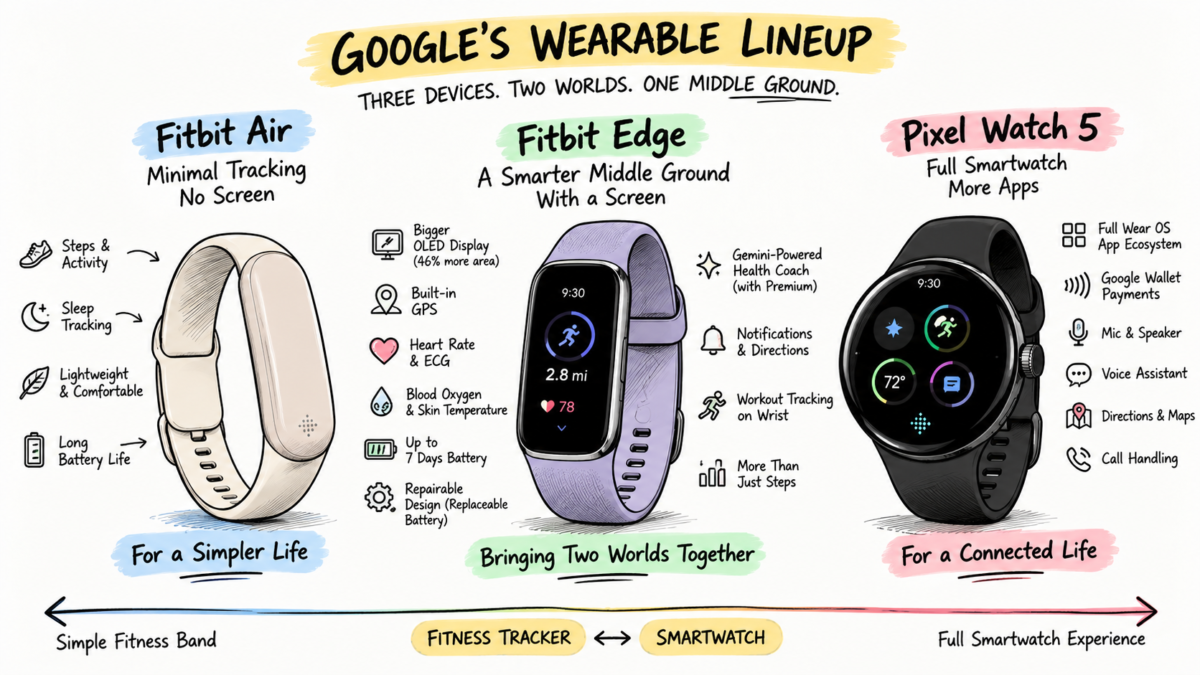
Google’s own lineup shows just how wide that gap has become. The screenless Fitbit Air focuses on low-distraction tracking, while the Pixel Watch 5 offers a more complete smartwatch experience. One is designed to stay out of the way; the other is built to do considerably more.
Yet there is a third kind of buyer: someone who wants to glance at workout stats, check a notification or see useful health information without turning their wrist into another miniature phone. They want the convenience of a screen, but they do not necessarily want an app store, voice controls and a stream of digital interruptions.
That is the gap Google wants the Fitbit Edge to fill. The challenge is that creating a middle-ground product is easy to describe and much harder to get right. Every feature you add increases its appeal to some buyers, while every feature you remove gives others a reason to walk away.
Google’s Answer Looks Simple Until You See What It Left Out
Announced on October 12, 2026, the Fitbit Edge brings a compact OLED display, built-in GPS and a collection of health sensors into a slim fitness tracker. Google says its screen offers 46% more viewing area than the Fitbit Charge 6, and its battery is rated for up to seven days under the company’s stated usage conditions.
Those numbers sound good, but the more interesting question is what they change in everyday life. Imagine finishing a run and checking your workout information directly on your wrist instead of pulling out your phone. You can see notifications, follow supported directions and record outdoor activities using the tracker’s own GPS. Small conveniences like these can make a wearable feel more useful without making it more complicated.
The health features go beyond counting steps, too. The Edge includes heart-rate monitoring, ECG functionality, blood oxygen tracking and skin-temperature sensing. Google is also connecting the device to its health platform and Gemini-powered Health Coach, although the coaching experience requires Google Health Premium after the included three-month trial.
There is another detail that deserves attention: Google describes the Edge as its first repairable fitness tracker, with a replaceable battery intended to help extend its useful life. That does not mean the battery is designed for users to swap themselves. Still, it raises a worthwhile question in a market where people can end up replacing an entire wearable when its battery no longer performs as it once did.
Put those features together and the pitch becomes clear. The Edge wants to be useful when you need it and forgettable when you do not. It promises enough screen to make information accessible, enough health tracking to offer more than basic activity stats, and enough battery life to avoid nightly charging under typical stated conditions.
But here is where the story takes a turn. Google has not simply built a smaller smartwatch and called it a fitness tracker. It has made a deliberate decision about what the Edge should never become, and some of those missing features could matter more than the ones on the box.
The Missing Features Are Not an Accident
The Fitbit Edge does not run the full Wear OS experience found on the Pixel Watch 5. It does not offer the same downloadable smartwatch app ecosystem, and there is no NFC chip for Google Wallet contactless payments. It also lacks a microphone and speaker, meaning you should not expect the same voice interactions or call-handling experience available on a full smartwatch.
These are not obscure technical details that only matter to gadget enthusiasts. Think about the moments when a smartwatch becomes genuinely convenient: tapping your wrist to pay for coffee, responding to something without reaching for your phone, or asking a voice assistant a quick question. The Edge does not aim to deliver that complete experience.
Google appears to be drawing a boundary between a wearable that helps you understand your day and one that tries to manage more of it. The Edge can keep tabs on your activity and put selected information in front of you. Your phone, meanwhile, remains the place for many of the tasks that require a broader software experience.
For the right buyer, that boundary could be a relief. Fewer smartwatch features may mean fewer distractions and a more focused device. Someone who primarily cares about running, sleep, activity tracking and quick notifications might never miss a digital wallet or a downloadable app.
But for someone else, those omissions could become daily annoyances. And at $179.99, buyers are entitled to ask why they should pay a premium over a basic fitness band for a device that still cannot handle some familiar smartwatch tasks.
The Edge’s biggest strength and its biggest weakness may be exactly the same thing: Google has chosen to keep it focused. Whether that feels like thoughtful design or unnecessary limitation depends on what you expect your wrist to do.
The $180 Question Google Cannot Avoid
Price is where Google’s idea faces its toughest test. The Fitbit Edge costs $179.99, compared with the Fitbit Air at $99 and the Pixel Watch 5 starting at $350 in the US. The Edge sits neatly between the two products in Google’s lineup. But a neat position on a pricing chart does not automatically make a product worth buying.
Someone considering the Fitbit Air has to decide whether a screen, built-in GPS and additional capabilities justify spending roughly $80 more. Someone looking at the Pixel Watch 5 faces a different calculation: is a simpler design and longer rated battery life worth giving up contactless payments, broader app support and other smartwatch features?
Neither comparison has an automatic winner. If you mostly exercise, monitor your health metrics and check a few notifications, the Edge could be a sensible fit. If you already rely on your smartwatch to pay for things, run apps and interact with an assistant, the Edge may feel like a step backwards, even if it costs less than a Pixel Watch.
There is also a recurring-cost question. Google includes three months of Google Health Premium, but the AI-powered Health Coach requires a subscription after the trial. Buyers should therefore distinguish between the capabilities included with the hardware and the personalised coaching experience that depends on an ongoing service.
This is becoming a familiar tension in consumer technology. Buying a device does not always mean getting every software experience associated with it indefinitely. We have seen a similar shift in Amazon’s Fire tablet strategy, where the relationship between hardware, software and connected services plays a major role in the overall experience.
A subscription is not automatically a bad deal. Useful coaching could make the Edge more valuable over time. But buyers need to know what remains useful without paying extra, what happens when the trial ends and whether the hardware alone justifies the price. A promising AI feature is not the same thing as proven long-term value.
This Could Be a Bigger Bet on How People Use Technology
The Fitbit Edge points towards a different philosophy of wearable technology. For years, the race has often been about adding more capabilities: more apps, more sensors, more ways to interact. Google is making a different bet here. Perhaps many people do not want their wearable to do everything. Perhaps they simply want it to collect useful information and show it at the right moment.
That idea fits the growing interest in personalised health insights. A wearable can gather patterns across activity, sleep and other measurements, while software attempts to turn those readings into recommendations. The real promise is not collecting the largest possible pile of data. It is helping people understand what that information might mean for their everyday routines.
Still, more data does not automatically lead to better decisions. Health features need clear explanations and sensible limitations, and consumer wearables should not be treated as substitutes for professional medical advice. Google’s health features are not intended to provide medical diagnosis, so users should understand what the measurements can and cannot tell them.
Trust matters for another reason, too. A device worn throughout the day can collect deeply personal information about a person’s habits and routines. Buyers need clarity about how the product works, which features require subscriptions and how long the company intends to support it. The repairable design is encouraging, but its real value will depend on how accessible battery replacement and ongoing support prove to be.
This wider shift is visible elsewhere in technology, too. Our coverage of Apple’s changing rules for AI agents on the Mac explored a related question: as software becomes more capable, who decides what it can do and how those capabilities are delivered? With wearables, that question becomes more personal because the technology sits on your body and gathers information about your life.
For Google, the Edge could bring more people into its health ecosystem without asking them to buy a full smartwatch. That is a potentially smart move. But the company still has to prove that the middle category is more than a convenient way to fill a gap in its product lineup.
Who Is the Fitbit Edge Really For?
The clearest target audience is someone who cares about fitness and health tracking but does not want a full smartwatch. They want to record a run without relying on their phone’s GPS, check activity information at a glance, monitor sleep and wear the device through the day without constantly thinking about charging.
For that person, the Edge could strike a useful balance. Its display makes information easier to access, its health sensors go beyond basic step counting, and its battery is rated for up to seven days under Google’s stated conditions. The repairable design may also appeal to buyers who would rather keep a device longer than replace it at the first sign of battery wear.
The Fitbit Air remains the simpler choice for someone who wants minimal distractions and is happy to check detailed information on a phone. The Pixel Watch 5 makes more sense for people who want a broader smartwatch experience, including a larger app ecosystem and features such as contactless payments.
The Edge sits between those options, but being in the middle does not automatically make it the best of both worlds. A successful compromise solves a specific problem better than either alternative. A forgettable one simply leaves buyers wondering why they should not spend less on one device or more on another.
That is why early excitement will tell only part of the story. The more important questions are whether people keep wearing the Edge after the novelty fades, whether they find its health features useful and whether the missing smartwatch functions become a daily frustration.
The Real Test Starts After the Launch
Google announced the Fitbit Edge at $179.99, with preorders open and retail availability scheduled for October 27, 2026. The launch gives buyers a new option between a screenless fitness band and a full smartwatch. But an announcement cannot prove that people actually want this particular combination of features and limitations.
The first test is practical: does the display make everyday tracking more convenient without sacrificing the comfort and battery life people expect from a fitness band? The second is financial: will buyers consider the price reasonable once they realise that contactless payments, a microphone, a speaker and a full smartwatch app ecosystem are missing?
Then comes the software. Google’s health platform and Gemini-powered coaching could become meaningful advantages, but their long-term value will depend on the quality of the guidance, transparent subscription terms and continued support. Those are things that cannot be settled by a launch presentation or a promising feature list.
We have explored related questions in our reporting on AI agents operating across the internet and NVIDIA’s approach to AI agent safety. In both cases, technology becomes more consequential as it takes on a larger role in everyday systems. With a wearable, the stakes are more personal: the device stays close to you and gathers information about your routines.
Ultimately, a wearable does not become essential because its specification sheet looks impressive. It becomes essential when it reliably solves the small problems that matter to its owner, without creating new frustrations in the process.
The Bottom Line
The Google Fitbit Edge is built around a genuinely interesting idea: people should not have to choose between a nearly invisible fitness band and a full smartwatch if neither fits their lives. Its screen, built-in GPS, health tracking and week-long rated battery life give Google a credible option in between.
But the $179.99 price puts pressure on that idea. The Edge lacks contactless payments, a microphone, a speaker and a full smartwatch app ecosystem, while some advanced coaching features require a subscription. These are meaningful trade-offs, not minor details buried in the fine print.
My take: Google may have identified a real gap in the wearable market, but the Fitbit Edge will succeed only if enough people want exactly this mix of capabilities and limitations. It does not need to be a smartwatch for everyone. It needs to be the right fitness companion for people who have been waiting for something in between.
Google says it has connected two worlds. The real test is whether buyers feel that it has solved a problem they actually had, or simply created a new choice they did not need.
Sources: Read Google’s official Fitbit Edge announcement, Ars Technica’s report on the features it leaves out, and TechCrunch’s coverage of Google’s wearable strategy.