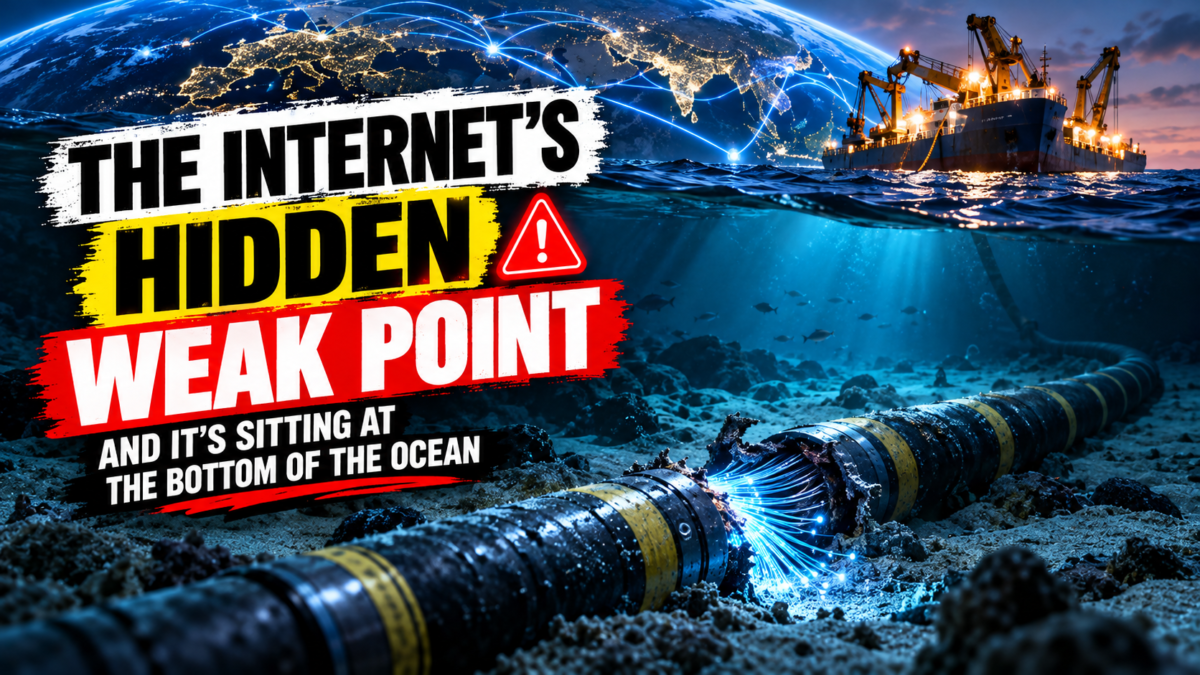

Imagine waking up tomorrow and discovering that your internet still works, but everything feels strangely slower. Video calls keep freezing. Websites take longer to load. Cloud services struggle to respond. And somewhere thousands of miles away, a ship’s anchor may have damaged a cable you never knew existed.
It sounds like the opening of a cyberattack thriller. But undersea internet cables carry more than 99% of international data traffic, connecting continents through fibre-optic lines hidden beneath the ocean. The digital world feels invisible, but its backbone is very real.
These cables aren’t forgotten backups from the early days of the internet. They help keep cloud services, international communications and businesses connected. The uncomfortable twist? Some of the most important pieces of modern technology are sitting on the seabed, exposed to risks most people never think about.
The question isn’t whether a cable can break. They do. The more interesting question is what happens when one breaks in exactly the wrong place.
The Internet Isn’t Floating in the Cloud. It’s Sitting at the Bottom of the Ocean.
When you picture the internet connecting two continents, you might imagine satellites sending information through space. It sounds logical. Space seems like the natural home for a technology that makes distance feel irrelevant.
But the reality is much more physical. Undersea internet cables connect continents, islands, coastal landing stations and data-centre networks. Inside them, optical fibres carry information as pulses of light, allowing huge amounts of data to travel across oceans.
Every time you open a website hosted on another continent, you probably don’t picture a cable lying on the seabed. You shouldn’t have to. The whole point of the internet is to make complicated infrastructure feel effortless.
Yet the cloud has a geography. A surprising amount of it is underwater. According to the International Telecommunication Union, submarine cables are essential infrastructure for global communication, finance and cloud services. In practical terms, undersea internet cables are part of the physical foundation that makes those services possible.
And that raises a strange question: if this network is so important, what does the hardware actually look like?
The Cable Is Smaller Than You Think. The Job It Does Is Enormous.
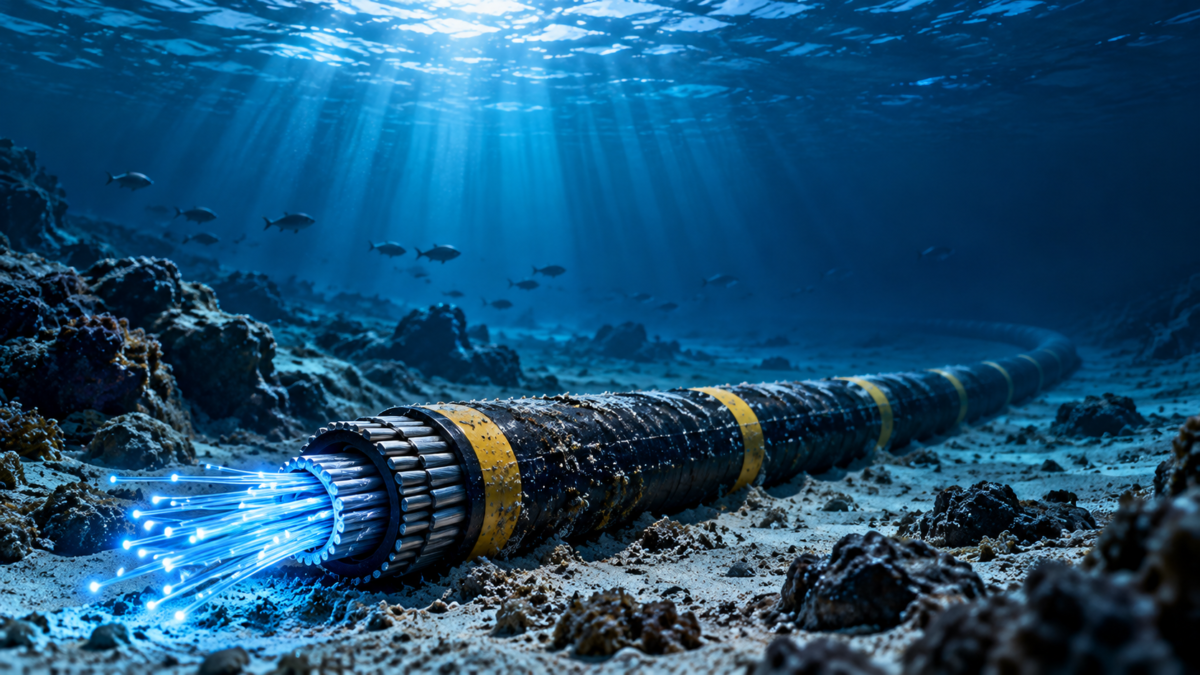
You might expect a cable carrying international communications to resemble a giant steel pipeline. In deep water, however, some submarine cables are roughly the diameter of a garden hose.
Inside are delicate glass fibres surrounded by protective layers. Depending on the design, cables may also contain metal components, insulation and electrical conductors. Near coastlines, where anchors and fishing activity create greater risks, cables often need heavier armour.
Why not make every cable massively thick? Because laying thousands of miles of heavy cable is expensive and technically difficult. Engineers have to balance protection, weight, installation requirements and the conditions along each route.
That creates a strange mismatch. A relatively slender physical structure can support communication used by millions of people, businesses and institutions.
Here is the part worth remembering: the internet’s importance is enormous, but the physical infrastructure carrying its international traffic can be surprisingly easy to overlook. The design of undersea internet cables reflects that balancing act between protection, cost and performance.
The Biggest Threat Isn’t Always a Hacker. Sometimes It’s an Anchor.
When people hear that an undersea cable has been damaged, their minds often jump straight to sabotage. A mysterious vessel. A deliberate attack. Someone trying to disconnect a country from the rest of the world.
Those possibilities matter when evidence points towards deliberate interference. But many cable faults have much more ordinary explanations: fishing gear, ship anchors, equipment failures and natural events such as underwater landslides.
The International Telecommunication Union reports that more than 170 cable repairs were recorded worldwide in 2025. Fault totals vary by source and counting method, but damage is a recurring maintenance challenge, not an imaginary edge case.
Consider the chain of events. A ship drops anchor. The anchor drags across the seabed. A cable gets caught or damaged. The vessel may have no idea it has affected infrastructure carrying international communications.
There is no need for a sophisticated cyberweapon. Sometimes, the danger comes from ordinary activity taking place in the same stretch of ocean as critical digital infrastructure.
That doesn’t mean every cable fault is suspicious, or that every incident threatens millions of users. It means protecting undersea internet cables requires dealing with everyday physical risks as well as deliberate attacks. Even an accidental anchor strike can damage undersea internet cables and trigger a complicated repair process.
For a deeper look at cable faults, TeleGeography explains what happens when submarine cables break and why most faults don’t become global internet emergencies.
One Broken Cable Doesn’t Kill the Internet. So Why Should Anyone Care?
Here is where the story gets more interesting. A damaged submarine cable does not automatically switch off the internet worldwide. If that were true, the global network would be far more fragile than it actually is.
Internet operators can often redirect traffic through alternative routes. This redundancy is essential: when one connection fails, other links may keep data moving between the same destinations.
But rerouting traffic is not the same as making the damage disappear. An alternative route may be longer. It may have less spare capacity. If several cables fail around the same time, the remaining connections may struggle to carry the extra load.
Think of a city with several bridges. If one closes, drivers can take another route. Traffic gets worse, but the city doesn’t stop functioning. Now imagine several bridges closing at once, with thousands of vehicles competing for the remaining roads.
That is the difference between an isolated cable fault and a disruption affecting several important connections. The consequences depend on where the damage occurs and how much alternative capacity is available.
The real vulnerability isn’t simply that a cable can break. It’s that some routes have better backup options than others.
This is why the resilience of undersea internet cables depends on more than strong protective layers. Network operators also need route diversity, spare capacity and practical recovery plans. When undersea internet cables are damaged, those backups can determine whether users notice a problem or barely notice anything at all.
The Ocean Has Digital Chokepoints. And That’s Where Things Get Uncomfortable.
Undersea internet cables do not spread evenly across the planet. They follow routes shaped by geography, cost, coastal access and the places where people and businesses need connectivity.
That means several cables can pass through the same narrow corridors. The Red Sea, for example, forms part of an important communications route linking Europe, Asia and the Middle East.
Concentrating infrastructure along a useful route can make economic and engineering sense. But it can also create a shared point of vulnerability. If several connections in the same area are disrupted, alternatives may not be enough to prevent congestion or service interruptions.
This is where an underwater engineering problem becomes a much larger issue. Businesses depend on cloud platforms. Financial services depend on reliable connectivity. Governments and ordinary users depend on networks that cross national borders.
A disruption at sea can therefore have consequences far beyond the location of the damaged cable. The effects vary, but the underlying principle is simple: digital networks are still shaped by physical geography. The routes taken by undersea internet cables can matter just as much as the amount of capacity those routes carry.
The APNIC analysis of submarine cable resilience explores why route diversity, repair capacity and network planning matter.
This physical layer of the internet is also connected to the wider technology story. In our coverage of AI agents exploring internet security boundaries, the challenge involved autonomous software. Undersea cables show a different side of digital security: the physical infrastructure that software depends on.
When a Cable Breaks, Someone Has to Find It. Underwater.
Now imagine engineers know a cable has failed. They still have to determine where the fault is, send a specialised vessel to the area and carry out a repair under challenging conditions.
Depending on the location and water depth, a repair crew may need to recover the damaged section, splice in replacement cable, test the connection and carefully return the repaired line to the seabed.
That is not exactly a quick trip to the local hardware store. Weather, sea conditions, access permissions, vessel availability and the complexity of the fault can all affect how long repairs take.
Some faults can be repaired relatively quickly. Others take much longer, especially when several incidents compete for limited repair resources.
And here is the overlooked detail: the internet’s resilience partly depends on a specialised fleet of ships and the people who operate them. Repairing undersea internet cables is a physical operation that can require pinpointing a fault, recovering a damaged section and carefully joining the line again.
We hear plenty about faster processors, bigger data centres and increasingly powerful AI models. Far less attention goes to the physical repair work that keeps the connections between these systems alive.
The ITU’s 2026 report on submarine cable resilience highlights repair readiness, risk mitigation and geographic diversity as important priorities.
Could Satellites Save Us If the Cables Went Down?
If underwater cables are vulnerable, moving the internet into space sounds like an obvious solution. Satellite internet has become increasingly useful for remote communities, emergency communications and locations with limited terrestrial infrastructure.
But satellites cannot simply replace all the capacity carried by the global submarine fibre network. Undersea cables are deeply integrated into the connections linking data centres, internet exchanges and major population centres.
Satellite connections can provide valuable alternatives in some situations. Their usefulness during a major outage, however, depends on available capacity, equipment, coverage and how the affected network is designed.
The more realistic answer is not cables versus satellites. It is a combination of diverse cable routes, terrestrial networks, satellite links where practical, and sufficient spare capacity to handle disruption.
In other words, the best way to make the internet more resilient is to avoid depending too heavily on any single path or technology. Satellites can help in some scenarios, but undersea internet cables remain central to the high-capacity connections linking continents.
That principle applies across technology. Whether the system involves cloud computing, autonomous agents or global data networks, reliability depends on what happens when one part fails. A similar focus on safeguards appears in our coverage of Microsoft’s call for an AI emergency brake.
Our article on NVIDIA’s safety approach for AI agents explores another example of designing systems with risks and safeguards in mind.
The Strange Twist: These Cables May Help Us Listen to the Ocean
So far, we have treated undersea cables as passive infrastructure: they carry data from one place to another. But researchers are also exploring whether fibre-optic systems can reveal information about the environment around them.
Some fibre-sensing techniques analyse tiny changes in light travelling through an optical fibre. Those changes can reveal vibrations and other disturbances, depending on the system and its setup.
That does not mean every internet cable is automatically an underwater surveillance system. The capabilities vary, and turning experimental methods into reliable monitoring systems involves technical and policy challenges.
Still, the idea is fascinating. Infrastructure designed to carry global communications may also help researchers or operators understand aspects of the environment around it.
The Lowy Institute’s analysis of fibre sensing explores this emerging possibility.
So, Could One Cable Cut Take Down the Internet?
Usually, no. But that doesn’t mean the risk is trivial. A single damaged cable may have little effect when strong alternative routes are available. The same fault can be much more disruptive in a region with limited connectivity or spare capacity.
Multiple faults affecting the same corridor can make the situation harder. Operators may have to redirect traffic across longer routes, manage congestion and wait for physical repairs.
That is why the most useful question is not whether the internet can survive one broken cable. It is whether the network has enough independent routes and repair capacity to cope when several things go wrong.
The internet is both remarkably resilient and dependent on physical infrastructure. Those two things are not contradictory. They are exactly why redundancy, maintenance and careful planning matter.
The Bottom Line
Undersea internet cables are among the least visible parts of modern technology, yet they help connect the world we use every day. These undersea internet cables use fibre-optic cores to carry international data, while ships, landing stations and maintenance crews keep the network functioning.
Anchors can damage cables. Fishing activity can cause faults. Important routes can converge in vulnerable areas. And repairs may depend on specialised vessels that cannot appear instantly.
But this is not a story about the internet being one cut away from total collapse. Multiple routes and network redundancy help keep the system working. The challenge is making sure those alternatives are strong enough when disruption happens.
The next time you send a message to someone on the other side of the world, it may feel as if your words travelled through thin air.
But somewhere along the way, your data may have crossed an ocean through a strand of glass lying on the seabed. And that hidden journey is one of the reasons the modern internet works at all.