
Imagine waking up on a Saturday morning with absolutely no plan.
You open Gmail. There is a hotel confirmation from a trip you booked weeks ago. Your calendar shows that the weekend is free. Google Photos reminds you of a place you visited last year. And somewhere in your YouTube history is a video about a hobby you keep saying you will try.
Each app knows a little piece of your life. But none of them knows the whole story—or at least, that is how it feels when you are the one switching between them.
Now imagine an AI that connects those little clues and turns them into a collection of illustrated stories, ideas, and suggestions made just for you. Not another endless feed of strangers’ opinions. Not another chatbot waiting for you to write the perfect prompt. Something that looks at the context you choose to share and says, “Hey, this might be interesting to you today.”
That is the idea behind Google Dreambeans, an experimental app from Google Labs that has arrived in India. It can use information from Google services you choose to connect—including Gmail, Calendar, Photos, Search, Gemini, and YouTube—to create personalized daily story collections.
The promise sounds wonderfully convenient. But it also raises a question that gets more personal with every new AI feature: How much of your digital life would you let an AI connect just to make your day a little more interesting?
Your Digital Life Is Already Telling a Story
Think about how much information you leave behind without really noticing.
You search for a destination before booking a trip. You save a restaurant in Maps or send its name to a friend. You receive a ticket in Gmail, add the travel date to Calendar, and take dozens of photos when you arrive. A few days later, you watch a video about the same place because you want to remember what you missed.
To you, those are separate moments. To a system that can connect them, they form a pattern: you are interested in that destination, you have been there, and you may want to explore it again.
The same thing happens with everyday interests. A search for running shoes, a calendar reminder to exercise, and a few saved workout videos may all point toward a goal you have been trying to start. Your apps have the clues. The problem is that the clues are scattered.
That is the space Dreambeans is trying to occupy. Rather than asking you to explain every interest from scratch, it uses selected context from your connected Google services to create stories that may feel relevant to your life. This is the central idea behind Google Dreambeans: use personal context to make discovery feel less generic.
It is a subtle change in how software works. For years, apps waited for you to search, tap, type, or ask. A more personalized assistant tries to notice what might matter and bring it to your attention before you think to ask.
Of course, noticing a pattern is not the same as understanding you. A search might have been for a friend. A photo might be from a one-time event. A calendar entry might have changed. Personal context can make technology more useful, but it can also give an AI the confidence to make a very human mistake.
Meet Dreambeans: A Different Kind of AI Feed
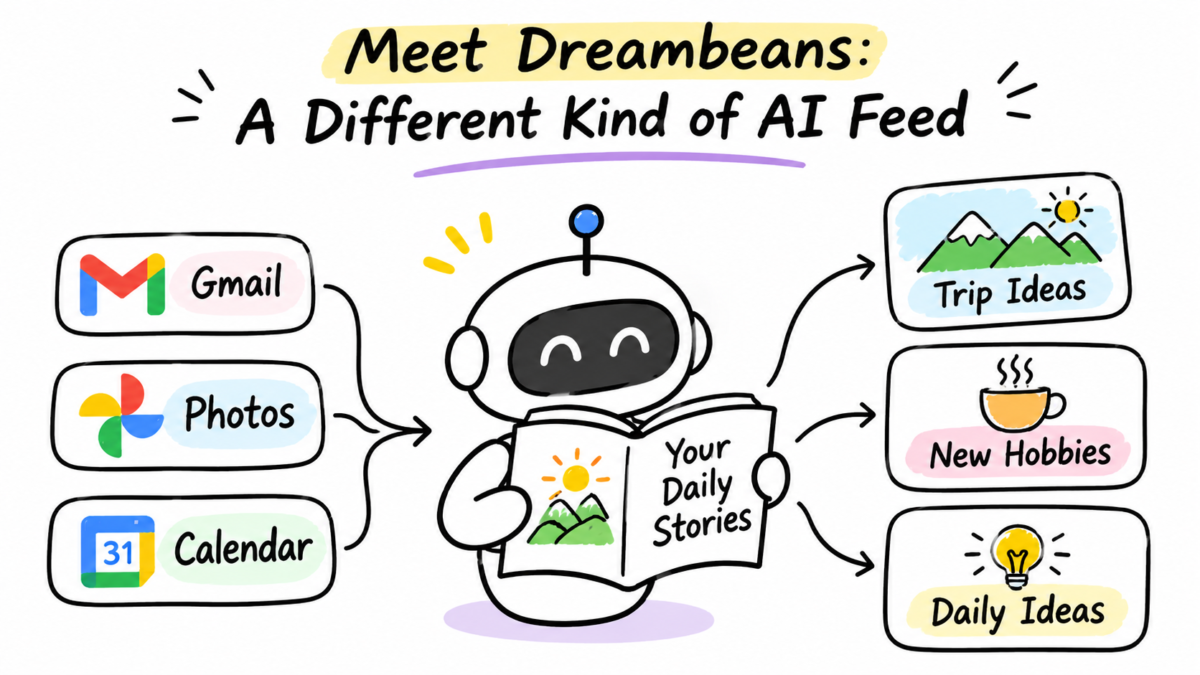
Dreambeans creates personalized, illustrated story collections using information from the Google services you choose to connect. The available sources include Gmail, Calendar, Photos, Search, Gemini, and YouTube.
The idea is to turn that context into a finite set of daily stories and suggestions. They might relate to your interests, upcoming plans, or things you have been exploring. You can open a story to learn more, save it, or share it.
That makes Dreambeans different from a conventional social feed. Most feeds are designed to keep refreshing. Dreambeans is presented as a small collection you can browse and then leave behind. The goal is discovery without an endless scroll.
It is also different from asking a chatbot, “What should I do this weekend?” In a normal chat, you provide the details that shape the answer. Dreambeans aims to use the context from services you have selected, so you do not have to reconstruct your plans and interests in every conversation.
Google introduced the experiment through its Google Labs announcement, describing a more personal way to discover ideas through daily stories. The important word is “experiment.” Dreambeans is not a finished digital life manager, and it should not be treated as one. Google Dreambeans is still an evolving example of how a personal AI experience might work.
Its appeal is easy to understand: instead of opening six apps to piece together your plans, you might see a useful idea in one place. Whether that idea is genuinely useful depends on how well the app interprets the information—and whether you are comfortable sharing that context.
For people curious about Google personal AI, Dreambeans offers a different approach: rather than simply answering questions, it tries to make selected personal information useful for discovery.
When Personalization Could Actually Help
Let’s make this less abstract.
Suppose you have been thinking about taking a short trip. You searched for places near Mumbai, watched a few travel videos, and saved some photos from a previous visit to the hills. Your calendar shows that next weekend is unusually free.
Normally, you might have to remember all of that yourself. You open a search engine, compare destinations, scroll through videos, check your calendar, and message your friends. Maybe you get excited and plan something. Maybe the tabs stay open until Monday.
A personalized AI could potentially connect those signals and surface a story about a nearby destination, an activity that matches your interests, or a place related to something you have already saved. It might give you a starting point instead of making you begin from a blank search box.
Or consider a smaller moment. You have watched several beginner cooking videos but never tried the recipes. A story collection could surface a simple recipe or an idea for a weekend cooking project. The usefulness is not that AI has invented a new hobby for you. It is that it may help you act on something you were already curious about.
These are examples of the kind of experience personalized AI is aiming for—not guaranteed Dreambeans features or promises about the exact stories it will generate. The app’s actual suggestions may vary depending on the context it can access and how it interprets that context.
That distinction matters because personalization can feel magical when it gets something right. It can feel intrusive or simply silly when it gets something wrong. AI-powered personalized stories are only as useful as the context and interpretation behind them.
Why the India Launch Matters
Dreambeans became available in India on November 3, 2026, for adults aged 18 and above. It is available on Android and iOS and supports English and 13 Indian languages, for 14 languages in total.
India is the first market outside the United States to receive the experiment. That makes the launch interesting beyond the app itself. Personal AI has to work in the context of how people actually communicate and organize their lives—not just in a single language or a single cultural setting.
For Indian users, language support can make the experience more accessible. But multilingual life is often messier than a language setting. Someone might search in English, chat with family in Marathi, watch videos in Hindi, and use a mix of languages in everyday conversation.
According to TechCrunch’s report on the India rollout, users choose one language for generated stories at a time. The app may draw on information in different languages, but it does not yet generate mixed-language stories such as Hinglish.
That is a practical limitation, especially for users who naturally switch languages depending on the situation. An assistant feels personal not just when it knows what you like, but when it communicates in a way that feels natural to you.
Google’s India announcement outlines the rollout, supported services, age eligibility, and language availability. As an experiment, Dreambeans may change as Google gathers feedback and learns how people use it.
The Big Trade-Off: Convenience Versus Privacy
Here is where the story gets serious.
Your Gmail may contain bills, travel bookings, personal conversations, and account information. Your Calendar can reveal your routines. Your Photos may include family, friends, and places you visit. Your search history can expose interests you have never discussed with anyone.
Connecting these services could make an AI more useful because it has more context. But the same context can be sensitive. The question is not simply whether an app uses AI. It is whether the information you give it is appropriate for the benefit you expect in return.
Google says users choose which services to connect and can disconnect them. The company also says Dreambeans’ data choices are separate from the choices users make for Personal Intelligence in other Google products. That separation is worth understanding before you assume one setting controls everything.
TechCrunch’s coverage reports that users can disconnect services, delete Dreambeans data, and ask the app to avoid certain subjects. The report also says generated stories are visible only to the account holder and that the app is intended for personal Google accounts rather than enterprise accounts.
Those controls are useful, but they do not make permission decisions automatic. Before connecting a service, ask what value it adds. If you only want ideas based on your interests, you may not need to connect every available source from the beginning.
And remember: a permission screen is not just a hurdle between you and a new feature. It is the moment you decide what parts of your digital life an app can use. Understanding AI privacy matters just as much as understanding the feature itself.
A Smart Way to Try Dreambeans Without Over-Sharing
If you are curious, you do not have to connect everything at once. Treat the first few days as an experiment of your own.
Start with the service that seems least sensitive and most likely to make the app useful. Browse the stories it generates. Notice whether they feel relevant, surprising, or intrusive. If the app gives you a useful suggestion, ask yourself what information helped it make that connection.
Then consider a few practical questions before adding more services: Does the app surface ideas you would genuinely use? Are the stories accurate, or does it make assumptions from incomplete context? Are you comfortable with the services you connected? Can you disconnect a source or delete the app’s data if you change your mind?
And perhaps most importantly: does this help you spend less time scrolling—or become another feed you check compulsively?
A product can promise to reduce endless scrolling, but the real test is what happens after you install it. If it gives you a useful idea and lets you move on, that is a different experience from an app that constantly demands your attention.
Personal AI should make your day easier, not create another obligation to check your phone. A personal AI assistant earns trust by being useful, transparent, and easy to control—not by asking for access to everything.
The Bigger Shift Toward Personal AI
For years, digital assistants mostly waited for instructions. You asked a question, searched for a place, or set a reminder. The emerging direction is more proactive: software tries to understand context and suggest what might help before you ask.
That shift is appearing across the AI industry. Some systems are being designed to work across tools and complete tasks, while others focus on helping users discover information. We have explored the broader rise of autonomous AI agents and internet security, as well as the growing attention to AI agent safety.
Personalization also depends on infrastructure. As AI systems process more context and generate more content, the demand for computing power grows. That connects to the larger questions explored in our coverage of AI data centers, chips, and their hidden costs.
Dreambeans is a consumer experiment, not proof that AI has solved personal assistance. But it offers a glimpse of a future where software tries to understand your life across services instead of treating every interaction as an isolated prompt.
The more personal these systems become, the more important it will be to give users clear choices, understandable controls, and the ability to say no.
Reality Check: Personalized Does Not Always Mean Useful
A beautifully illustrated story can still be wrong. A recommendation can be based on a real search but miss why you made it. A calendar entry may have changed. A photo may represent a one-time event rather than a lasting interest.
That is why AI-generated personal stories should be treated as suggestions, not facts about what you want or who you are. Check details before acting on recommendations, and use feedback controls when a story feels irrelevant or uncomfortable.
Dreambeans is also experimental. Its availability, features, and quality may change. The best way to evaluate it is not by the launch announcement, but by whether it consistently saves you time and offers ideas you would not have found otherwise.
And if the app does not feel useful, you do not owe it access to more of your life just because it is new.
The Bottom Line
Google Dreambeans is an intriguing attempt to make AI feel personal in an everyday way. It connects selected details from your Google apps and turns them into a limited collection of illustrated stories, ideas, and reminders.
The appeal is easy to understand: fewer scattered tabs, less searching, and potentially more relevant inspiration. The trade-off is equally clear: the more personal context an AI can use, the more carefully you should think about permissions and privacy.
If you try it, start with a small set of connected services and judge it by the value it brings—not by how much of your digital life it can access. The best personal AI should help you notice what matters, then give you your time back.