

Somewhere above Earth, a machine was asked to write a poem.
It had no keyboard. No desk. No human sitting beside it to help. Just a satellite moving through space, a computer chip built for artificial intelligence, and a planet turning silently beneath it.
Then, after weeks of preparation, the answer arrived.
“Blue marble below
Data streams in silent grace
Starlight feeds my core.”
That little poem was more than a cute space message. It was the first AI response from a data-center-class processor in orbit, according to Google. And it marked a small but fascinating step toward a future where some of the computers powering our AI world might live beyond Earth.
The experiment is called Project Suncatcher. Its ambition is enormous. Its first success was almost disarmingly simple: a satellite ran an AI model, answered a prompt, and sent the result home.
The Day a Satellite Answered Back
On October 1, 2026, Google’s Project Suncatcher prototype launched into orbit aboard a SpaceX rideshare mission. The satellite was built in partnership with Planet, the Earth-imaging company.
But getting there was only the beginning. For the next few weeks, the team worked through its commissioning checklist: powering up the spacecraft’s systems, bringing its onboard hardware online, and running early machine-learning tests.
Then came the moment the team had been waiting for.
During a pass over a ground station, engineers sent a prompt to the satellite. Onboard was Gemma 4, Google’s open AI model. The request was simple: write a haiku about being in space.
As the satellite passed over Svalbard, Norway, the response was received on Earth. Three lines. A few words. A tiny message from a machine circling the planet.
Google called it a “Hello World” milestone. In software, Hello World is the classic first program: proof that a system can run and produce output. Here, the output had travelled across the space between Earth and orbit.
For a moment, the future of computing looked like a poem.
What Was Actually Flying Above Earth?
It is tempting to imagine a giant orbital computer, glowing like a science-fiction city. The reality is much smaller—and more interesting.
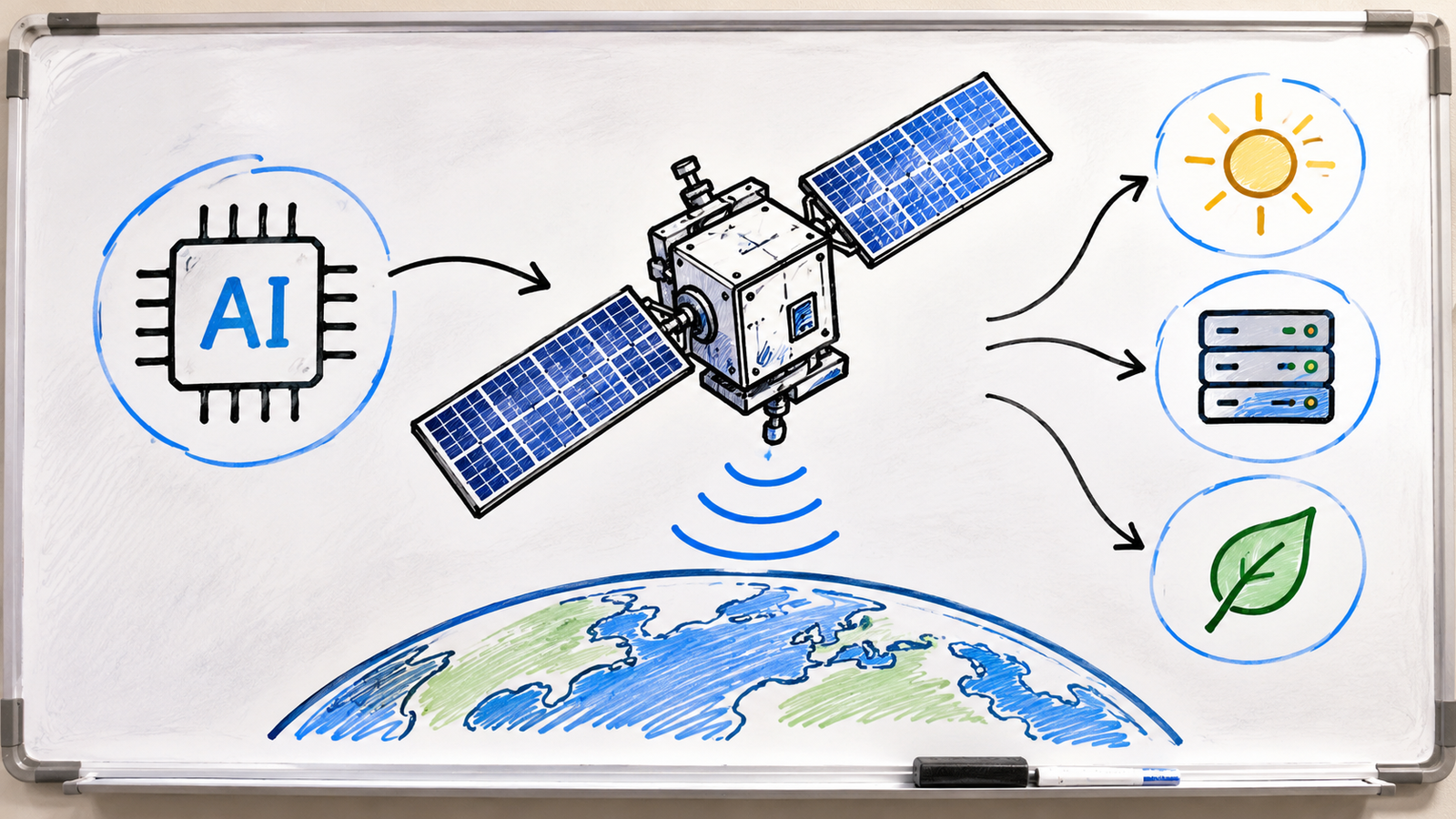
Project Suncatcher’s first satellite is a prototype. It carries Google’s Tensor Processing Units, or TPUs: specialized chips designed to accelerate machine-learning workloads. The spacecraft was built to test whether this kind of AI hardware can operate reliably in orbit.
That distinction matters. This was not a satellite providing a new AI service to the public. It was an experiment designed to answer a basic question: Can data-center-class AI hardware work in space at all?
And the first answer was encouraging. The onboard model ran, generated a response, and the satellite transmitted that response back to Earth.
But a successful poem is not the same thing as a successful space data center. The hardest tests are still ahead.
Why Would Google Put AI in Space?
To understand the idea, look at the problem AI is creating back on Earth.
Modern AI needs enormous amounts of computing power. That means chips, electricity, cooling systems, buildings, and the infrastructure that connects them. As AI use grows, the demand for computing capacity—and the energy to run it—grows too.
Now look up.
In certain orbits, solar panels can receive sunlight for much longer periods than they would at many locations on Earth. Google’s long-term concept explores whether satellites could use that energy to power AI computing, then communicate with one another through optical links.
Instead of building every future computer on the ground, the company is investigating whether some of them could operate in orbit, powered by sunlight and connected in a network.
It is a bold idea. It is also a very early one.
The dream is not “AI in space.” The dream is a new kind of computing infrastructure.
The Satellite Has a Problem: Space Is Not a Server Room
On Earth, engineers can rely on familiar comforts: air, stable temperatures, technicians nearby, and the ability to replace a failed component. A satellite gets none of those.
Space brings two especially difficult challenges for computer chips: radiation and heat.
Radiation can interfere with electronic components. In some cases, it can flip a bit in memory—a tiny change that may corrupt data or disrupt a computation. A chip that works perfectly in a laboratory still has to prove it can keep working in the real orbital environment.
Then there is heat. A powerful processor uses energy and produces heat, but in a vacuum there is no surrounding air to carry that heat away. Engineers must manage it through carefully designed thermal systems, including radiators.
And power is limited. Reporting on the prototype says it can run only one of its four TPUs at a time, in short operating windows. That is a long way from a continuously running terrestrial data center.
So the satellite’s first poem proves an important but narrow point: the hardware and software completed an AI task in orbit. It does not yet prove that the system can handle large workloads continuously, cheaply, or at scale.
The real story begins after the first successful answer.
The Next Chapter: Two Satellites, One Bigger Test
Google’s next planned milestone is more ambitious. The company says it aims to test two interconnected satellites in 2027.
Why two? Because a network is more than one computer floating alone. The long-term concept depends on satellites communicating with one another, sharing work, and functioning as parts of a larger system.
Google’s research explores using free-space optical links—essentially laser-based communication between satellites—to move data at high speeds. That would be a crucial step toward an orbital computing network rather than a collection of isolated machines.
But the 2027 test is still a milestone on a research roadmap, not a promise that orbital data centers are about to replace Earth-based ones.
Could Space Data Centers Really Change Computing?
Potentially. If engineers can solve the power, cooling, radiation, communications, and launch-cost challenges, space-based infrastructure could become another way to add computing capacity.
That does not mean every AI request will travel to orbit. Many applications need low latency, and moving data between Earth and satellites introduces its own constraints. Hardware also has to survive launch and operate with limited opportunities for repair.
There are economic questions too. Getting equipment into orbit is expensive, and a system that works technically may still be too costly to operate. Google has not demonstrated a commercially competitive orbital data center with this prototype.
For now, Project Suncatcher is a research bet: test the hardware in space, learn what fails, and see whether the idea can grow beyond a single satellite.
The Reality Check: A Poem Is a Beginning, Not a Breakthrough Product
It is easy to turn this experiment into a headline about AI leaving Earth. The more useful interpretation is quieter.
Google has shown that its prototype can run an AI model in orbit and return a response. That is a meaningful engineering milestone. The company still needs to test how its chips withstand radiation and thermal stress, how reliably they operate over time, and whether multiple satellites can work together.
There is no public service to sign up for, no orbital chatbot to use, and no evidence that space-based computing is ready to replace terrestrial data centers.
Yet the experiment is worth watching precisely because it is so early. The first step toward an unfamiliar technology often looks small when compared with the vision behind it.
In this case, that first step happened to rhyme.
Bottom Line
Project Suncatcher’s satellite sent a poem from orbit after running Google’s Gemma 4 model on an onboard TPU. The demonstration confirms that an AI task can run on this hardware in space and that its response can make the journey back to Earth.
The bigger ambition is to explore whether solar-powered satellites could one day form a network for AI computing. Before that future arrives, Google has to solve some very earthly engineering problems: reliability, heat, radiation, communications, and cost.
For now, one satellite has said hello. The next question is whether it—and the network that may follow—can keep talking.
Related reading: The hidden cost of AI data centers · Google’s Gemini AI developments · The undersea cables connecting our digital world
Sources: Google’s first response from the Project Suncatcher satellite · Project Suncatcher prototype launch · TechCrunch’s reporting on the satellite